
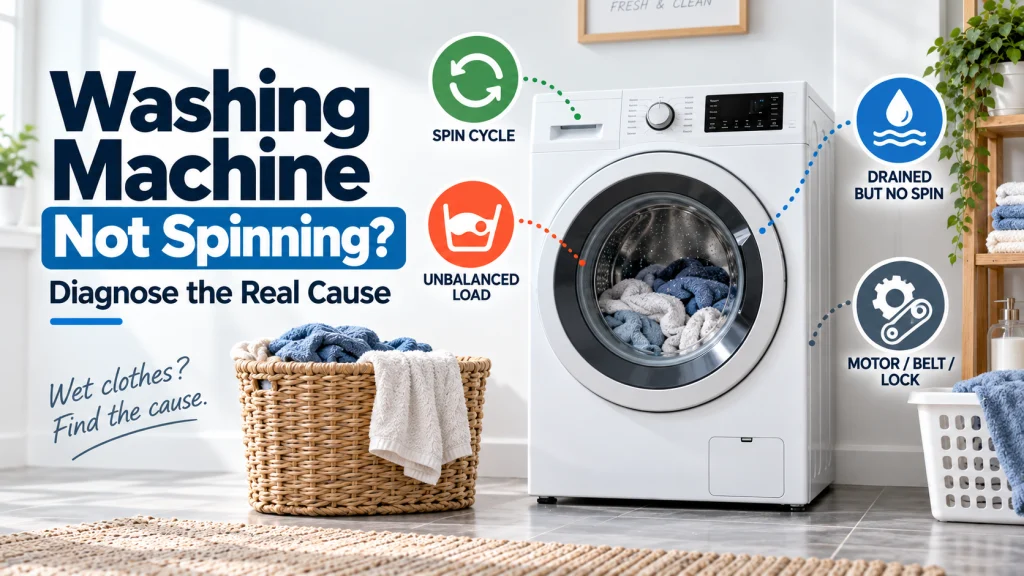
If the water has drained but the drum will not reach a proper spin, the next clue is what the washer does instead: rebalance, pause, hum, lock, turn slowly, or stay completely still.
A washing machine that will not spin invites expensive guesses. Owners often jump straight to the motor, belt or control board because the clothes are still soaking wet. In practice, the spin stage is guarded by several conditions. The machine may refuse high speed because it has not drained, cannot balance the load, thinks the door or lid is open, is full of suds, is not level, or cannot prove that the drum is moving safely.
The useful way to troubleshoot it is the same way a good appliance technician approaches the call: establish what the machine can still do, then test the cheapest and safest conditions before naming a failed part. A washer that repeatedly tumbles and adds water is not behaving like a washer whose motor hums while the basket stays still. Those are different fault paths.
Quick answer: First confirm whether the washer actually drained. If water remains, diagnose the drain path before the spin system. If the drum is empty, check the selected spin setting, load balance, levelling, detergent/suds and the door or lid lock. Only after those are ruled out do belt, clutch, coupling, actuator, motor feedback, bearings or control faults move up the list.
Safety first: Stop using the washer if it repeatedly trips a breaker, GFCI or RCD, smells electrically hot or burnt, leaks onto electrical parts, or the drum is scraping, seized or visibly out of position. Unplug it before checking accessible parts. Never bypass a lid switch, door lock, earth/ground connection or other safety interlock.
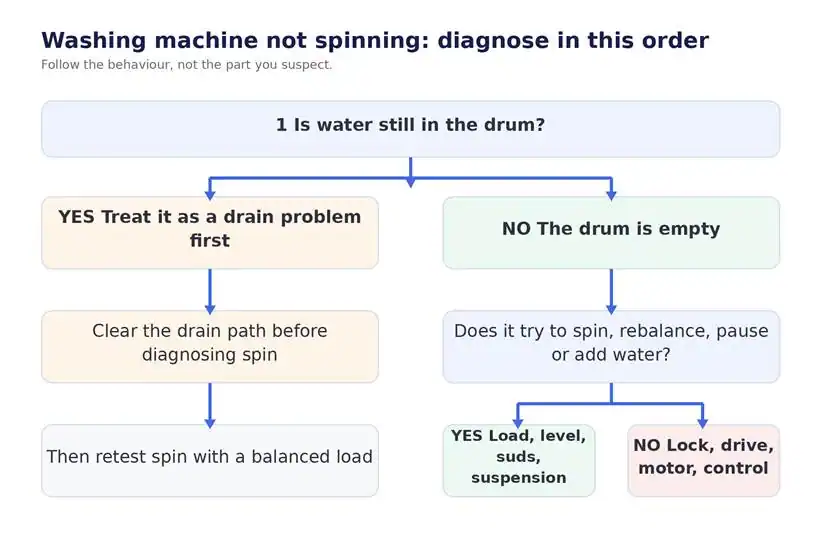
Figure 1. The fastest way to separate a drain problem from a genuine spin problem.
In this guide 19 sections
What “not spinning” actually means
Before opening a filter door or ordering a part, watch one spin attempt. The pattern is often more useful than the final symptom “clothes are wet”.
| What you see or hear | What it usually means first | Best first check |
| Water remains in the drum | The washer may be blocking spin because drainage is incomplete | Drain hose, filter if fitted, household drain |
| It tumbles, pauses, then tries again | The control is trying to balance the load | Redistribute load, check load size and level |
| It adds water during spin | Often an automatic rebalancing attempt, not a fill fault | Load distribution and bulky/single items |
| It drains but never turns the drum | Safety interlock or drive system becomes more relevant | Door/lid lock state, error code, then drive |
| It spins slowly but clothes stay very wet | Low spin setting, imbalance, suds or incomplete drainage | Cycle/spin setting, suds, balance, drain performance |
| It spins empty but fails with laundry | Load/suspension or a weak mechanical drive is more likely | Balanced test load, suspension behaviour |
| It roars, scrapes or the drum has play | Mechanical damage is more plausible | Stop and inspect with power off; arrange repair if severe |
First question: did the water leave the drum?
This is the most important split in the diagnosis. Modern washers normally need to complete drainage before they allow a full-speed spin. Current manufacturer guidance from Samsung, Bosch and LG places drain checks early in spin troubleshooting for exactly this reason.
If water is still visible, or you hear the pump running for a long time without the level dropping, use the dedicated washing machine not draining guide before continuing here. A blocked filter, kinked hose, obstructed household waste or weak pump can leave you with soaking clothes and make the fault look like a drive problem.
A partial drain restriction can be more deceptive. The tub may look empty by the time you open the door, yet the machine may have taken too long to empty and therefore reduced, delayed or abandoned high-speed spin. If the pump sounds strained, the drain is unusually slow, or the problem appeared at the same time as a drain code, do not skip the drainage path just because there is no puddle left at the end.
Run one controlled spin test
Do not keep running full wash programmes. Use the shortest model-approved Spin, Drain & Spin, or Rinse & Spin programme and watch what happens. The goal is to create one repeatable test, not to “shake the fault loose”.
1. Remove any item that is obviously unsuitable for the machine, such as a heavy rubber-backed mat if the manual excludes it.
2. Use a modest, balanced load of several similar ordinary garments. A single heavy item or one very small garment can be harder for the washer to balance than a sensible load.
3. Select a normal or high spin speed that is safe for those items. Check that “No Spin”, “Rinse Hold” or a delicate programme has not been selected.
4. Start the spin and stay nearby. Note whether the washer drains, locks, tumbles slowly, accelerates, backs off, adds water, displays a code or makes a new sound.
5. If the behaviour repeats, stop there. The repeatable pattern is now useful evidence. Do not run five more cycles hoping for a different answer.
LG and Samsung both describe slow initial rotation, pausing and repeated distribution attempts as part of the machine trying to balance the load before high speed. On some models, water may be added again during this process. That can look like the washer has “gone backwards”, but it may simply be trying to correct an uneven load.
If it keeps redistributing, pausing or adding water
This pattern usually points towards balance before it points towards a motor. Modern washers monitor how smoothly the drum accelerates. If the load is concentrated on one side, the machine may slow down, tumble the load, add water, try again and eventually finish with a reduced spin or no full-speed spin at all.
The counter-intuitive part is that both very large and very small loads can cause this. One bathmat, one duvet cover, a pair of heavy jeans, or a few light items can clump together. A packed drum can also stop items moving freely enough to redistribute.
- Pause the programme and untangle the load rather than simply pushing it down.
- For one heavy absorbent item, add a small number of compatible items only if the manufacturer allows it. The aim is to distribute weight, not to overload the drum.
- If the problem happens only on bedding, towels or one specific programme, compare the result with an ordinary mixed-cotton load.
- Check that all feet contact the floor and the cabinet does not rock diagonally when pushed at the top corners.
- If the machine has recently been installed or moved, confirm all transit/shipping bolts and spacers were removed as the manual requires.
Hotpoint UK explicitly says its machines can abort spin when an unstable load cannot be redistributed. Samsung and LG describe the same behaviour, including long pauses and repeated balancing. So a cycle that appears “stuck at 9 minutes” or keeps changing its remaining time can be a load-balancing problem rather than a frozen control board.
If it spins empty but not with clothes
This is one of the most useful mechanic-style clues because it says the system can physically spin under little or no load. The next question is why it loses the ability once weight and imbalance are introduced.
Start with the simple explanation: the test load may itself be difficult to balance. If a normal balanced load still fails while an empty test succeeds, inspect how the tub behaves. Excessive bouncing, repeated out-of-balance errors or the tub taking a long time to settle can point towards worn suspension rods on many top loaders or worn shock absorbers on many front loaders.
On older mechanical top loaders, a worn clutch or drive component can also spin an empty basket yet slip under the weight of wet laundry. On some older induction-motor designs, a weakening start/run capacitor can reduce torque. These are model-specific faults, not universal parts to order from a symptom alone.
A useful community example came from a UK owner whose machine would not reach final spin with a small load. Adding a sensible amount of compatible laundry allowed the machine to balance and complete the spin. The lesson is not “always add more clothes”; it is that a load can be too small or too uneven for the balancing logic even when nothing is broken.
If it drains but never attempts to spin
Once drainage, load and settings are ruled out, the safety interlock becomes more important. A top loader must know that the lid is closed and, on many modern models, locked before the basket can spin at speed. A front loader similarly needs a confirmed door-lock state.
Watch the lock indicator and listen to the sequence. A repeated click from the latch area followed by a cancelled spin, a lid/door code, or a lock light that never reaches its normal state is more informative than simply saying “it does nothing”. Do not defeat the switch with a jumper. Apart from the injury risk, bypassing the interlock destroys a useful diagnostic signal.
GE and Maytag both document lid-lock behaviour as a condition for spin on top loaders. Samsung error guidance also separates some door and unbalanced-load codes. If the machine is telling you that the lid or door state is wrong, resolve that before assuming the motor controller has failed.
If you hear the motor or a hum but the drum does not move
A sound from underneath does not prove the motor is healthy, and it does not prove the motor is bad. First work out which component is making the sound. The drain pump can hum while the drive motor remains off. On a top loader, the drive motor may run while a coupling, clutch, belt or shift mechanism fails to transfer motion to the basket.
With the washer unplugged and empty, turn the drum or basket gently by hand if your model allows it. It should move without feeling mechanically locked. Some magnetic direct-drive machines have noticeable magnetic resistance, so “not completely free” is not the same as seized. Stop if you hear harsh scraping, feel a hard jam, see the inner drum sitting crooked, or find excessive up-and-down play.
On belt-driven machines, a broken or thrown belt can give a classic “motor sounds alive, drum stays still” symptom. However, many modern washers use direct-drive or other beltless systems, so do not order a belt until you know your exact model uses one.
Real-world repair patterns worth learning from
Forum and repair-community threads are useful when they are treated as patterns, not proof. The same symptom can have different causes on different machines. These cases are valuable because they show where owners lost time and what finally changed the diagnosis.
| Real-world pattern | What eventually mattered | The lesson |
| Older Whirlpool-style top loader drained but would not spin | After coupling and clutch work, a sock was found mechanically obstructing the system | Do not keep replacing drive parts without checking for a physical obstruction |
| UK washer would not reach a proper final spin on a small load | A better-balanced load allowed a normal spin | A very small or mixed-weight load can be the fault condition |
| Bosch washer showed drain/spin trouble despite filter checks | A £2 coin and lint were found deeper in the hose near the pump | A clear visible filter does not prove the entire drain path is clear |
| Top loader repeatedly went out of balance without bearing roar | Repair discussion focused on suspension rods before bearings | Use sound and tub movement to separate suspension from bearing suspicion |
| Older washer began spinning after lid was opened and closed | Community diagnosis focused on lid switch/timer state rather than the motor | A change triggered by the lid/lock sequence points towards control/interlock logic |
The first case is particularly instructive. The owner had already replaced plausible parts and still had no proper spin. The eventual obstruction was simple but hidden. That is why this guide keeps diagnosis in an order: prove the symptom path before buying parts.
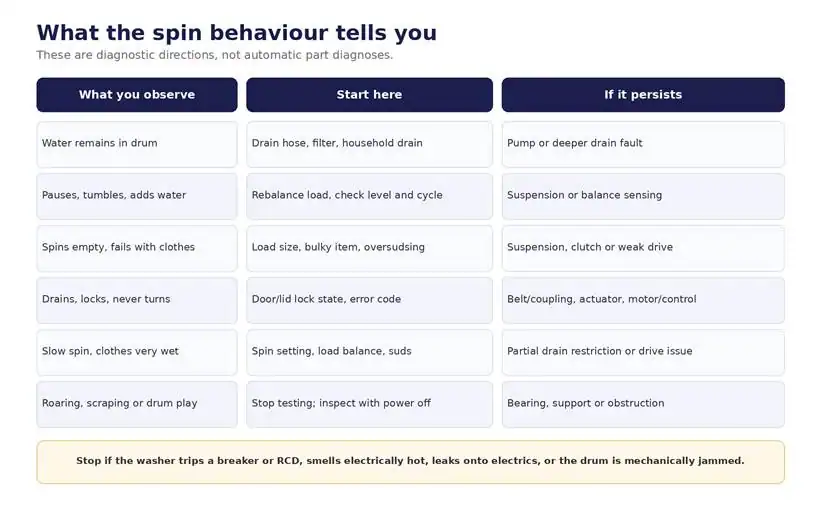
Figure 2. Match the observed behaviour to the next diagnostic area. These are directions for testing, not automatic part diagnoses.
If it spins, but clothes are still soaking wet
A washer can technically spin and still fail to extract water properly. This is where the selected programme, spin speed and detergent matter.
- Check the selected spin speed. Delicates, wool, bulky or hand-wash programmes may deliberately use a low spin, and some models allow “No Spin” or “Rinse Hold”.
- Reduce oversudsing. Too much detergent, or the wrong detergent in a high-efficiency washer, can interfere with draining, rinsing and spin performance.
- Watch for repeated rebalancing. If the drum never commits to high speed, the clothes can finish far wetter than normal even though no error appears.
- Recheck drainage. A partial restriction may allow water out eventually but not quickly enough for the control to permit the expected final spin.
- Compare the result across loads. If cottons spin normally but one bulky or delicate programme does not, the programme may be working as designed.
GE and Whirlpool both specifically list slow spin selection, oversudsing and unbalanced loads as reasons clothes can remain unusually wet. LG similarly notes that some cycles intentionally use a lower spin speed and that imbalance can reduce the achieved speed.
If the washer is new, recently moved or suddenly “walks” during spin
Treat installation as part of the fault. A front loader with transit bolts still fitted can shake violently and may never settle into a normal high-speed spin. A machine that rocks on its feet or sits on a flexible floor can repeatedly trigger balance protection.
Do not remove random rear bolts because somebody online called them “shipping bolts”. Use the installation instructions for the exact model. Once they are correctly removed, keep them for future moves if the manufacturer recommends it.
If the washer used to spin correctly in the same location and has gradually become more unstable, worn suspension becomes more plausible. Top loaders commonly use suspension rods; front loaders commonly use springs and dampers/shock absorbers. Severe tub movement under load is a better clue than age alone.
Front loader versus top loader: where the fault path differs
The first checks are similar, but the deeper mechanics can be very different. That is why a forum answer for a twenty-year-old Whirlpool top loader should not be copied to a modern direct-drive front loader.
| Area | Front loader | Top loader |
| Safety interlock | Door lock must confirm closed/locked state | Lid switch or lid lock must confirm safe state |
| Balance control | Drum distributes load before high-speed spin; shocks and springs matter | Basket balance and suspension rods commonly affect high-speed spin |
| Drive | May be belt-driven or direct-drive depending on model | May use belt, clutch, splutch/actuator, gearbox/transmission, coupling or direct drive |
| Drain filter | Many front loaders provide an owner-accessible pump filter | Many top loaders do not expose a user-serviceable pump filter |
| Older motor designs | Some older UK/EU machines use replaceable carbon brushes | Older US designs may use clutches/couplings and mechanical drive components |
Carbon brushes deserve special caution in UK advice. They were a common failure on many older brushed-motor machines and can cause weak, intermittent or absent spin. But many newer inverter and direct-drive motors do not use carbon brushes at all. Checking for “worn brushes” without first identifying the motor type is how a reasonable old repair tip becomes bad modern advice.
Error codes and indicator behaviour that can narrow the fault
Always use the model manual for the final meaning because manufacturers reuse letters and codes differently. A few current manufacturer examples are still useful as patterns:
- Samsung: Ub, U6, Ur and UE-family messages can indicate an unbalanced load on many models. Samsung notes that a Ur message may mean the washer is adding water and retrying balance before another spin attempt.
- LG: UE indicates an imbalance condition on many front- and top-load models. LG also points to load amount and machine levelling.
- GE: some top-load models show “bALAnCINg”, a flashing SPIN light or UE when the load cannot be balanced well enough for normal spin.
- Hotpoint UK: on some models, a flashing spin indicator can mean the machine judged the load excessive or unbalanced.
- Door/lid codes: these make the interlock path more relevant. Do not bypass the lock to prove the point; use the manual and the machine’s normal test procedure.
When the simple checks are ruled out: the parts that genuinely become plausible
At this stage, model number matters more than generic advice. The following components can cause no-spin faults, but not every washer contains every component.
- Drive belt: broken, thrown, glazed or slipping on a belt-driven washer.
- Motor coupling: found on some older direct-drive top loaders, where the motor can run but torque does not reach the transmission.
- Clutch or basket drive: can slip under a wet load on some older top-loader designs.
- Shift actuator or splutch: on some high-efficiency top loaders, the mechanism has to switch the drive between wash/agitate and spin.
- Suspension rods or shock absorbers: excessive movement can stop the control from accepting a high-speed spin even when the motor is capable.
- Door or lid lock assembly: if the control cannot confirm the safe state, it may not authorise spin.
- Motor speed feedback: tachometer/Hall sensor or related wiring can prevent the control from knowing whether the drum is accelerating as commanded.
- Motor inverter or control board: possible after simpler conditions and wiring are ruled out, but expensive enough that model-specific diagnosis matters.
- Bearings or drum support: more likely when no-spin or poor-spin is accompanied by roaring, roughness, sag, scraping, leaks at the tub seal or excessive drum play.
A technician should test these against the machine’s service information rather than replacing them in the order listed. The order above is not a “most common parts” ranking; it is a map of what becomes plausible once the owner-level checks are exhausted.
What not to do
- Do not bypass a lid switch or door lock to make the machine spin with the opening unsecured.
- Do not assume “motor noise” means the motor is the failed part. The sound may be the pump, or the motor may be running while a drive component is not transferring motion.
- Do not replace the drain pump just because the clothes are wet if the machine already drains quickly and completely.
- Do not repeatedly reset the machine before recording the error code and behaviour. A reset can erase the clue without repairing the condition.
- Do not continue testing a washer that is scraping hard, tripping electrical protection, leaking internally or smelling burnt.
- Do not copy a carbon-brush, clutch or belt diagnosis from another brand until you confirm your machine actually uses that design.
When to stop and book a repair
Professional diagnosis is the sensible next step when the washer drains normally, the load and installation are correct, the door/lid state is normal, and it still will not attempt or complete spin. It is also time to stop if the drum is mechanically rough or jammed, there is severe bearing noise or drum play, the machine repeatedly trips a breaker/GFCI/RCD, or access to the suspected part requires powered testing or major disassembly.
When you call for service, give the technician the sequence rather than your part guess. “It fills and washes, drains completely, the lid locks, the motor hums, but the basket never moves” is far more useful than “I think it needs a motor”. Include the model number and exact code.
Related washing machine guides
For a wider symptom map, start with Washing Machine Troubleshooting: Diagnose Common Problems by Symptom.
If the washer still has water in the drum, go to Washing Machine Not Draining? Diagnose the Real Cause before chasing spin components.
Browse the growing Washing Machines troubleshooting category for the rest of the cluster as new symptom guides are published.
Frequently asked questions
Why does my washing machine drain but not spin?
Once drainage is proven, check spin settings, load balance, machine level and the door or lid lock. If the washer still never attempts to rotate, the drive system, motor feedback or control path becomes more plausible. The exact design depends on the model.
Why are my clothes soaking wet if the washer finished the cycle?
The washer may have completed with a reduced spin because of imbalance, oversudsing, a low spin setting or slow drainage. Watch a separate spin attempt rather than assuming the cycle finishing means full spin speed was achieved.
Why does my washer spin empty but not with clothes?
First rule out a difficult load. If a balanced normal load still fails while the empty basket spins, worn suspension or a drive that slips under load becomes more plausible on some designs.
Why does my washer keep adding water during the spin cycle?
Some washers add water while trying to redistribute an unbalanced load. Samsung and LG both document this kind of retry behaviour. If it repeats on normal loads, check levelling, load size and suspension rather than assuming the inlet valve is opening by mistake.
Can too much detergent stop a washer from spinning properly?
Yes. Excess suds can interfere with rinsing, drainage and the control’s ability to reach the expected final spin. Use the detergent type and dose specified for your washer and water conditions.
Can a blocked drain cause a no-spin fault even if the drum looks empty later?
Yes. A partial restriction can slow drainage enough to delay or reduce the spin even if the remaining water eventually leaves. If the pump runs for a long time or the drain flow is weak, troubleshoot the drain path.
Does a washing machine always have a belt?
No. Many machines are direct-drive or use other drive arrangements. Confirm the model before ordering a belt.
Should I replace carbon brushes if my washer will not spin?
Only if your exact motor is a brushed design and testing supports that diagnosis. Many modern inverter and direct-drive motors have no carbon brushes.
The bottom line
A washing machine that will not spin is easiest to diagnose when you stop treating “wet clothes” as the diagnosis. First prove drainage. Then watch whether the machine tries to balance, locks normally, turns slowly, hums without movement, or spins only when unloaded. Those behaviours separate load and installation problems from interlock, suspension and drive faults.
Most expensive mistakes happen when somebody jumps from “not spinning” straight to “bad motor” or “bad control board”. The better approach is slower for five minutes and faster overall: confirm what still works, reproduce the fault once, follow the machine’s sequence and only move to internal parts when the evidence points there.
Sources
- Samsung US – Washing machine spins poorly
- Samsung US – Washing machine does not spin at all
- Samsung UK – What to do if your washing machine is not spinning
- LG USA – Washer does not drain or spin / clothes too wet
- LG USA – Washing machine drum not spinning
- LG USA – UE imbalance error
- Whirlpool – 8 reasons why your washing machine is not spinning
- Whirlpool Product Help – Not spinning, front load washer
- GE Appliances – Top load washer does not spin
- GE Appliances – Clothes still wet after spin
- Maytag – Lid locking on a top load HE washer
- Bosch UK – Washing machine is not spinning
- Hotpoint UK – Washing machine troubleshooting
- Electrical Safety First – Washing machine safety
- Reddit r/appliancerepair – Drains but will not spin, repair discussion and update
- Reddit r/Appliances – Top loader repeatedly unbalanced
- WasherHelp UK forum – Clothes sopping wet after spinning
- UK Whitegoods forum – Bosch E36/E10 not spinning