
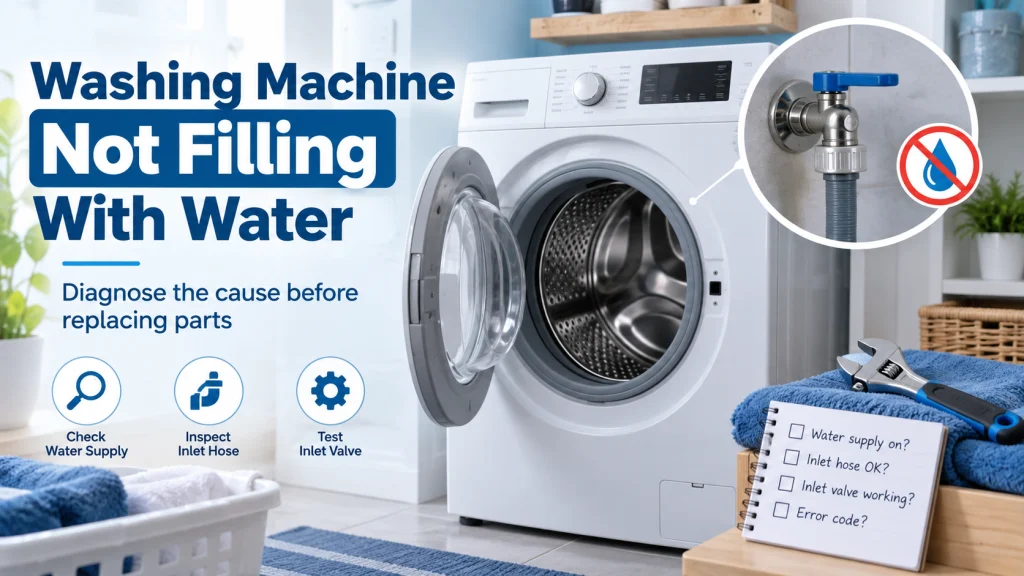
A washing machine that starts a cycle but leaves the drum bone dry can make the inlet valve look guilty straight away. Sometimes it is. Quite often, it is not. The washer may never have asked for water because the door did not lock, the control thinks the tub is already full, or the drain hose is quietly siphoning water out as fast as it comes in. A restricted tap, crushed hose or small patch of sediment in an inlet screen can create the same complaint without any failed electronic part at all.
The fastest diagnosis is to watch one fill attempt from the beginning. Listen for the door or lid lock, notice whether the drum moves to sense the load, listen for a click or hum near the water inlet, and watch whether you get no water, a weak trickle, only hot or cold water, or water that arrives and then disappears. Those details decide what should be checked next.
Quick answer: If the washer is genuinely trying to fill, start outside the machine. Confirm the correct water supplies are fully open, inspect the fill hoses, test that the taps can deliver a strong flow, and clean the inlet screens as the manufacturer describes. If one temperature works and the other does not, stay on that side of the water path. If water comes in and immediately drains away, check the drain-hose installation for siphoning. An inlet valve, pressure-sensing system, door/lid lock or control fault moves higher on the list only after those simpler causes have been ruled out.
Safety first: Turn off the water and unplug the machine before disconnecting fill hoses or cleaning accessible inlet screens. Stop if there is active flooding, water near electrical parts, a burnt smell, repeated breaker/GFCI/RCD trips, or if the next test would require live-voltage measurements. Do not bypass a door or lid lock and do not energise a loose inlet valve from the mains.
In this guide 18 sections
Start with what the washer is actually doing
Before you move the machine or order a valve, run one short wash or rinse programme and stay beside it for the first few minutes. The useful clue is the sequence, not the final message on the display.
| What you see or hear | What it points towards first | Best next check |
| No water, no click or hum, door/lid does not confirm locked | The machine may not have reached the fill command | Start/cycle selection, door or lid closure, lock status and displayed code |
| A click or hum near the rear, but no water | Supply restriction, blocked screen or inlet valve unable to pass water | Taps, hose flow, inlet screens, then model-specific valve diagnosis |
| Water enters as a weak trickle | Restricted supply, kinked hose, blocked screen or low pressure | Compare tap flow, inspect hose and clean screens |
| Cold fills but hot does not, or the reverse | One side of a dual-inlet system | That tap, that hose, that screen and that valve solenoid |
| Water enters and seems to disappear | Possible siphoning through the drain hose | Drain-hose height, insertion depth and air gap against the exact installation manual |
| Water level looks low but the cycle continues normally | May be normal on a high-efficiency washer | Check the programme and model manual before treating it as a fault |
| Fill error appears after a delay | Machine did not reach the expected water level in time | Record the exact code, then check supply, hose, screens and siphoning before parts |
This first observation is worth doing even if you already have an error code. A fill code tells you what the control failed to see. It does not, by itself, tell you which part caused it.
Make sure it is a real no-fill problem
Modern high-efficiency machines do not always fill the way older washers did. A top loader may lock, make a few short basket movements, pause while it estimates the load and then add water in stages. A front loader may use surprisingly little visible water. If the clothes are moving, the cycle progresses and no fill error appears, a low-looking water level can be normal rather than a failed inlet system.
Whirlpool, for example, documents sensing spins and staged water additions on some top-load models. The amount of water can also change with the programme. Do not force extra water into a machine simply because the load is not submerged the way it was in an older deep-fill washer. Check the manual for the model first.
If the machine is doing something broader than a fill fault, use Washing Machine Troubleshooting: Diagnose Common Problems by Symptom to get back to the right branch of the cycle.
Check the water supply before you touch a washer part
This sounds basic, but it catches more than freshly installed machines. A tap can be left half closed after plumbing work, a lever valve can look open when it is not fully in line with the pipe, and a hose can be crushed when the washer is pushed back into its space.
- Confirm the correct supply tap or taps are fully open. A single-inlet machine may use only cold water. Many US machines have separate hot and cold inlets, and some models expect both supplies to be available even for a cold programme.
- Look behind the washer without yanking it forward. Check that the fill hose is not flattened against the wall, folded sharply, twisted or trapped under the appliance.
- If the hose can be disconnected safely, turn the water off first. Put the hose end into a bucket or deep sink, then briefly open the tap and compare the flow. Weak flow here means the washer cannot fix the problem for you.
- If household flow is poor at the tap itself, the next call may be plumbing rather than appliance repair.
Bosch uses a simple bucket check in its support guidance and says roughly 10 litres per minute should come from a fully open tap for the machines covered by that guidance. Samsung UK publishes a pressure range of 0.5 to 8 bar for its 4C/4E water-supply troubleshooting. Treat those as manufacturer examples, not universal numbers for every washer. Your model manual wins if it specifies something different.
A clogged inlet screen can turn a healthy supply into a trickle
Where the fill hose meets the washer, a small mesh screen catches grit before it reaches the inlet valve. It is easy to overlook because the tap can blast water into a bucket while the washer still receives very little through a screen packed with sediment or mineral scale.
This is especially worth checking after water-main work, a well-pump problem, a long shut-off, or any plumbing repair that may have stirred debris. One recent appliance-repair case involved a washer that kept showing an inlet error after low well pressure had been fixed. The household flow was strong again, but sediment was still sitting in the washer inlet screens.
- Unplug the washer and close the water supply.
- Place a towel and shallow tray behind the machine. There will usually be some water left in the hose.
- Remove the fill hose at the washer and inspect the screen in the inlet connection.
- Clean it only in the way the manufacturer describes. Some manufacturers tell you to brush the screen in place. Do not pry out a fixed screen simply because a generic video shows somebody doing it.
- Reconnect the hose carefully, restore the water and check the coupling for leaks before running a cycle.
If the hose itself has internal damage, a collapsed liner, a severe kink or an anti-flood device that is restricting flow, cleaning the screen will not solve it. Whirlpool specifically warns that some anti-flood devices can reduce the amount of water reaching certain washers.
If only hot or only cold water works, use that clue
A washer that fills normally on cold but fails on hot has already done you a favour diagnostically. The control can run a cycle, the tub is capable of accepting water, and at least one inlet path works. Stay on the failed side instead of testing the whole machine again.
- Check the affected household tap first.
- Check that specific hose for a kink or internal restriction.
- Inspect the screen on that inlet.
- If supply and screen are good, the matching inlet-valve solenoid or its control path becomes more plausible.
Do not assume a cold wash means the hot supply is irrelevant. Some North American washers mix water even on a nominally cold setting or monitor both supplies. Whirlpool states that both hot and cold lines must be connected and open on the models covered by its fill guidance. By contrast, many UK and European machines are built around a single cold-water feed. That regional difference is why the hose layout on somebody else’s washer is not a reliable template for yours.
Water comes in, then disappears: check for siphoning
This one fools people because the washer is obviously capable of opening the inlet valve. The drum never reaches the expected level because the same water is leaving through the drain hose. The control keeps asking for more, times out, or reports a long-fill fault.
A drain hose can siphon when it is installed too low, pushed too far down a standpipe, or sealed so tightly that the plumbing cannot breathe properly. Whirlpool lists drain-hose installation as a cause of F8 E1 and LF fill errors for some models. GE also documents low drain-hose placement as a reason a washer can keep filling instead of reaching level.
Do not copy one brand’s measurements into another machine. Whirlpool gives specific insertion and standpipe-height limits for particular models, while GE publishes different figures for some of its washers. Use the installation sheet for the exact model and check three things: hose height, how far the hose enters the drain, and whether the connection has the required air gap.
If there is standing water as well as a fill complaint, first confirm the drain side with Washing Machine Not Draining? Diagnose the Real Cause.
If the washer hums but no water enters
A hum can be useful, but only after you identify where it is coming from. The inlet valve is usually at the rear where the fill hoses enter. The drain pump is normally lower in the cabinet. A pump running during an error routine can sound like the washer is trying to fill when it is actually draining for safety.
If you can hear or feel the inlet valve being energised and you have already proved strong water flow to the hose, a blocked inlet screen or a mechanically stuck inlet valve becomes more likely. If the screen is clean and the correct supply reaches the valve, the valve may need model-specific testing or replacement.
A generic resistance number from the internet is not enough to condemn a valve. Coil specifications vary, and a solenoid can measure electrically intact while the valve is mechanically restricted. The opposite is also true: no water does not prove the valve is faulty if the control never sent it a fill command.
No valve sound? The washer may not be asking for water
When there is no obvious inlet click or hum, step back to the conditions the washer needs before it will open the valve. A front loader may require a confirmed door lock. A top loader may need the lid state and cycle logic to be satisfied. A machine that never reaches the fill command can leave the tub just as dry as a blocked tap.
- Close the door or lid firmly and make sure laundry is not trapped in the latch area.
- Watch the lock indicator. Repeated clicking, a lock error or a latch that never confirms closed points away from the water supply.
- Make sure the cycle really started. Some machines require the Start button to be held rather than tapped.
- Record any code before resetting power. A reset can clear the display without fixing the reason the fill command was refused.
If the door/lid state is normal and the water supply is proven good, the diagnosis moves inside the machine. Wiring to the inlet valve, the water-level sensing system and the control board are now reasonable possibilities. This is the point where a model-specific service sheet matters more than a generic parts list.
The water-level sensor can create a no-fill fault without blocking any water
The washer needs some way to decide how much water is in the tub. Older designs often use a pressure switch connected to an air hose. Many newer machines use an electronic pressure sensor. If that system falsely reports that the tub is already full, the control may skip or shorten filling even though the taps and valve are capable of working.
Pressure-system faults can come from the sensor itself, a loose or damaged pressure hose, a blocked air chamber, wiring, or the control interpreting the signal incorrectly. An older top loader that begins agitating almost immediately with an empty tub is a different clue from a machine that sits silently waiting for a door lock.
Real repair threads are useful here because they show why part-swapping is expensive. In one 2026 case, a top loader still would not fill after the inlet valve and household pressure had been ruled out. The behaviour pointed towards the water-level pressure system, and clearing the air path restored filling. That does not mean every owner should start blowing into pressure hoses. Modern sensors can work differently, access may require cabinet removal, and an incorrect test can create a second fault. It means the pressure system deserves consideration when the water path has been proven good.
When the inlet valve really does become the leading suspect
By the time a technician suspects the valve, the diagnosis should sound more specific than “the washer has no water”. A stronger case looks like one of these:
- Strong flow from the household supply reaches the washer hose, but the machine will not pass water through a clean inlet screen.
- One temperature works normally and the other side stays dead after the tap, hose and screen on that side have been proven good.
- The valve clicks or hums during the fill command but no meaningful flow gets through.
- The fault is intermittent and changes with a particular inlet path, while the rest of the washer operates normally.
- Water seeps into the tub while the washer is switched off. That is the opposite failure mode: a valve that is not closing fully.
Even then, match the replacement to the full model number. Valve assemblies can look almost identical while using different connectors, flow restrictors, coil arrangements or temperature paths.
Brand error codes that often point back to the fill system
Error codes are most useful when they confirm the behaviour you have already observed. The same letters can mean something different on another brand, and code families change between model generations.
| Brand/code family | What the manufacturer describes | Where to start |
| Samsung 4C / 4E / E1 / nF / nF1 on applicable models | Water-supply or insufficient-fill condition | Supply hoses, inlet screens, flow/pressure and model-specific hose setup |
| LG IE | The washer did not reach an adequate water level within the expected time | Tap, hose, kinks, frozen/restricted supply, then inlet system |
| Whirlpool / Maytag F8 E1, LF, Lo FL on applicable models | The washer is not detecting the correct incoming-water amount or is taking too long to fill | Supply, hoses, inlet screens and drain-hose siphoning |
| GE H2O Supply on applicable front loaders | Water supply or pressure-sensing problem; very low pressure is also possible | Confirm supply is on; persistent code after supply check needs model-specific service |
| Bosch tap/faucet warning and related inlet codes on applicable models | Low pressure, blocked inlet filters, closed tap or kinked inlet hose depending on the model | Tap flow, inlet filter and hose, then exact model guidance |
For the exact code on your machine, use the FixDecoded Error Code Decoder rather than guessing from a code used by another brand.
If the problem started after moving, installation or plumbing work
A sudden no-fill fault immediately after something changed deserves a different first pass from a machine that failed in the middle of an ordinary week. Before blaming an internal part, retrace the change.
- Was a shut-off valve closed and never fully reopened?
- Did the washer get pushed back far enough to crush a hose?
- Were hot and cold hoses reversed on a dual-inlet model?
- Was the drain hose pushed deeper into the standpipe during reinstallation?
- Did plumbing or well work release grit that is now sitting in the inlet screens?
- Was an anti-flood hose or new connector added that restricts flow?
- If the machine was moved in freezing weather, could a supply line or hose still be frozen?
These checks are cheap, fast and tied to the timing of the fault. A part that happened to fail on the same day as a move is possible. A hose that was pinched during the move is usually the better first theory.
A technician-style decision path
If you want the short version, work through the fault in this order. Stop as soon as the evidence points somewhere specific.
| Step | Question | What the answer changes |
| 1 | Did the cycle really start and confirm the door/lid state? | If no, diagnose start/lock logic before the water system. |
| 2 | Is there good water flow from the household tap? | If no, solve the supply/plumbing problem first. |
| 3 | Are the fill hoses open, unkinked and flowing freely? | If no, correct or replace the restricted hose. |
| 4 | Are the inlet screens clear? | If no, clean them as the manufacturer instructs. |
| 5 | Does only one temperature fail? | If yes, stay on that supply/valve side. |
| 6 | Does water enter and then disappear? | If yes, check drain-hose siphoning and installation. |
| 7 | Does the valve click/hum with proven supply but pass no water? | The inlet valve now deserves model-specific testing. |
| 8 | No fill command despite good supply and normal lock? | Pressure sensing, wiring or control logic moves up the list. |
What not to do
- Do not buy an inlet valve simply because the drum is dry.
- Do not remove a fixed inlet screen unless the manufacturer tells you to. Damaging the screen can send debris directly into the valve.
- Do not bypass a lid or door interlock to make the washer continue.
- Do not use one universal drain-hose height or insertion depth. Installation limits vary by model.
- Do not apply mains power directly to a loose valve or probe live control wiring unless you are trained and following model-specific service information.
- Do not keep resetting the washer before you record the exact error code and behaviour. The code is evidence.
- Do not keep running test cycles if the machine is leaking onto electrical areas or the supply connection cannot be made watertight.
When it is time to book a repair
Professional diagnosis makes sense once the household supply is strong, the hoses and screens are clear, the drain hose is installed correctly, the door or lid state is normal, and the washer still refuses to fill or repeatedly returns the same inlet error. It is also the right point to stop if the suspected test requires cabinet removal, live voltage, control-board measurements or pressure-sensor diagnosis that is not described in the owner manual.
Give the technician the sequence instead of a part guess. “The door locks, cold water flows strongly from the hose, the inlet screen is clean, I hear a click at the rear, but no water enters and the machine shows IE after several minutes” is useful. “I think it needs a valve” is much less useful. Include the full model number and the exact code as displayed.
Frequently asked questions
Why is my washing machine not filling with water but making a humming noise?
If the hum is coming from the inlet area, the valve may be energised but unable to pass water because the supply is closed, a screen or hose is restricted, or the valve is mechanically stuck. First prove water reaches the washer. Also make sure the noise is not the drain pump running as part of an error routine.
Can low water pressure stop a washing machine from filling?
Yes. A modern washer can time out if it does not receive water quickly enough. Check the tap flow first. Some manufacturers publish minimum pressure or flow guidance, but use the specification for your exact model rather than a generic number.
Why is my washer filling very slowly?
Slow fill usually sends you back to the same path: partially closed tap, kinked hose, clogged inlet screen, restricted anti-flood hose, poor household pressure or an inlet valve that is not opening properly. Compare hot and cold separately if the machine has two inlets.
Why does the washer fill with cold water but not hot water?
That narrows the fault to the hot side on a dual-inlet machine. Check the hot tap, hot hose and hot-side inlet screen before suspecting the matching valve solenoid. Reverse the logic if hot works and cold does not.
Can the drain hose make a washing machine look like it is not filling?
Yes. If water siphons out through an incorrectly installed drain hose, the washer may keep adding water yet never reach the expected level. Check the model-specific hose height, insertion depth and air-gap instructions.
Can a reset fix a no-fill problem?
A power reset can clear a temporary control state on some machines, but it will not open a closed tap, clean an inlet screen, correct siphoning or repair a failed component. Record the error first, then use a reset only if the manufacturer recommends it.
Why did the problem start after moving the washing machine?
Look for what changed physically: a supply valve left closed, a hose pinched behind the cabinet, reversed hot/cold connections, a disturbed drain hose or sediment released into the inlet screens. Those are usually worth ruling out before an internal fault.
Is a low water level always a sign that the washer is not filling properly?
No. High-efficiency machines can use much less visible water than older designs and may add it in stages after sensing the load. Treat it as a fault when the machine times out, displays a fill error, does not wet the load as designed or clearly fails to progress normally.
The check I would do first
If I arrived at a washer with a dry drum, I would not open the cabinet first. I would watch one start sequence, prove that the correct tap can deliver water, inspect the hose and inlet screen, and see whether the fault affects both temperature paths. Those checks tell you whether you are dealing with plumbing, a restricted inlet path, siphoning or a machine that never issued the fill command. Only then does it make sense to test an inlet valve, pressure system or control.
If the washer is also leaking during the fill attempt, use Washing Machine Leaking Water? Find Where the Leak Is Coming From to separate a supply-side leak from an internal leak.
For a guided symptom route, the FixDecoded Fault Finder can narrow the next checks from what the machine is actually doing.
Sources
- Samsung UK: 4E/4C water-supply error
- LG USA: IE water inlet error
- Whirlpool: F8 E1 / LF / Lo FL fill error and hose checks
- GE Appliances: front-load washer no fill
- GE Appliances: washer will not stop filling / siphoning check
- Bosch UK: washing machine not filling with water
- Reddit r/appliancerepair: pressure-system no-fill case, March 2026
- Reddit r/appliancerepair: sediment after low well pressure, September 2026
- Reddit r/Appliances: drain-hose siphoning case