
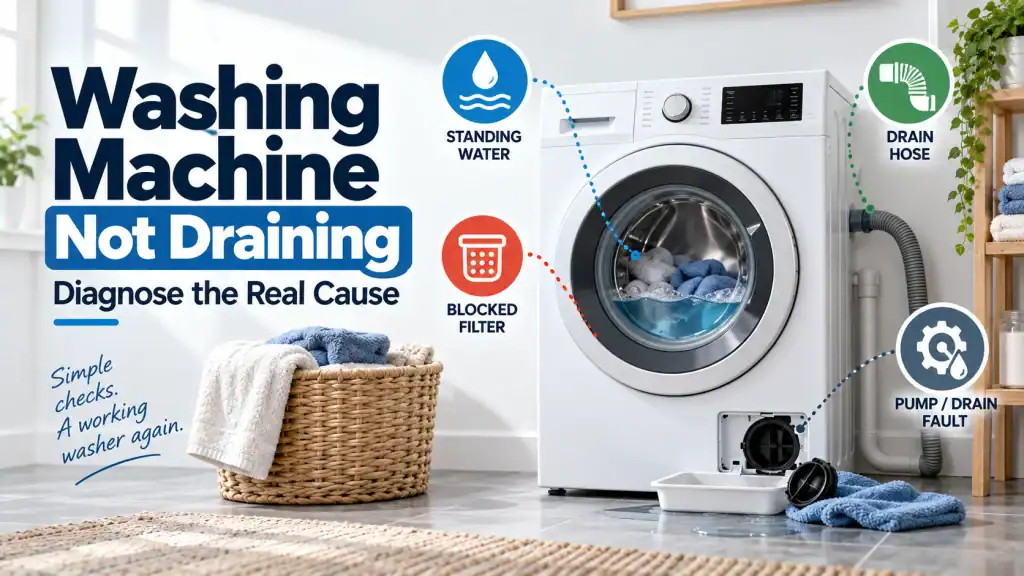
Standing water does not automatically mean the drain pump has failed. Trace the water path, listen to what the washer does, and separate a simple blockage from a pump or plumbing fault before replacing parts.
A washing machine not draining is one of those faults that can look more expensive than it is. The machine stops with wet clothes and water in the drum, the door may stay locked, and the spin cycle may never begin. It is easy to jump straight to “bad pump”. In practice, the problem can be as simple as a kinked hose, a coin in a filter, an under-sink waste connection packed with lint, too much detergent, or a programme option that is intentionally holding the final rinse water.
The useful question is not just whether water is present. Ask how quickly it drains, whether you can hear the pump, whether the water leaves when the hose is moved to a bucket, and whether the problem began suddenly after a particular load. Those clues usually tell you where to look next.
Quick answer: If the tub is full of water, record any error code, let hot water cool, unplug the washer, then check the external drain hose and household drain. On a front-loader with a user-accessible pump filter, drain the residual water before removing the filter and clear debris. If the pump hums but little water moves, suspect a restriction or damaged impeller. If the washer drains strongly into a bucket but not into the normal waste connection, the appliance may be fine and the household drain may be blocked.
Safety first: Do not open a pump filter while a hot cycle has just finished. Do not bypass a lid or door lock, power a loose pump directly from the mains, or work on live wiring. Stop if the washer trips the electrics, smells burnt, leaks onto electrical parts, or requires panel removal beyond the user instructions.
In this guide 19 sections
Diagnose the symptom before opening anything
Two washers can both finish with water inside and have completely different faults. Use the behaviour as your first filter:
| What you notice | What it points towards | First check |
| Tub remains almost full and the pump hums | A blockage in the filter, sump hose or drain hose, or a jammed/worn pump impeller | External hose, accessible filter, impeller area |
| Tub remains full and there is no pump sound | Pump not being driven, pump motor failure, wiring/control fault, or the cycle has not reached drain | Error code, programme state, lid/door status, model diagnostics |
| Water drains very slowly | Partial blockage, kinked hose, restricted household drain, suds or a weakening pump | Hose route, filter, sink trap/standpipe |
| Water drains into a bucket but not the normal waste | Household plumbing or under-sink connection is restricted | Standpipe, trap, siphon/spigot |
| Water leaves, then appears again | Backflow or siphoning caused by hose installation or plumbing | Hose insertion depth, height and air gap per the manual |
| No drain only after bulky or heavily soiled loads | Load debris, lint, small fabric items, or excessive suds | Filter and drain path, detergent dose |
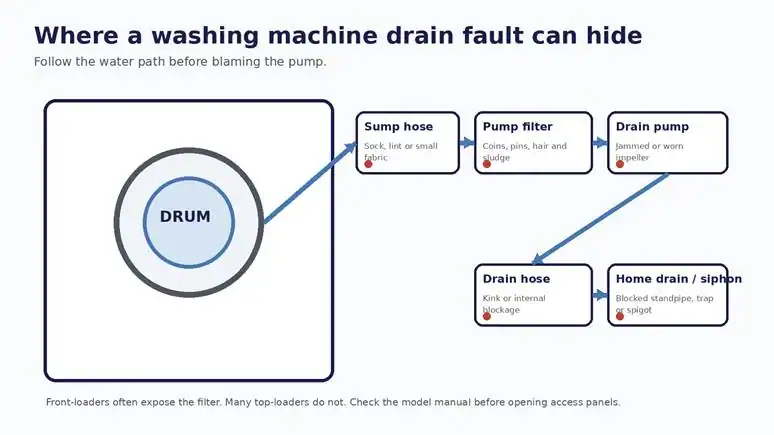
Figure 1. Follow the water path. A no-drain fault can sit before the pump, inside the pump, after the pump, or in the home drainage connection.
First, get the standing water out safely
A front-loader often keeps the door locked while it still senses water. Do not force the door. Many front-loaders provide a small emergency drain hose beside the pump filter, but some models do not. Top-loaders are even less consistent, and many do not give the owner direct access to the pump or filter.
1. If the last programme used hot or sanitising water, give the water time to cool. Samsung specifically warns that residual water after a hot cycle can be hot enough to cause injury.
2. Switch the washer off and unplug it. Put towels down and use a very shallow tray or baking sheet if floor clearance is tight.
3. If your manual shows an emergency drain hose, pull it out only as far as instructed, remove its cap and drain a small amount at a time. A full drum can contain much more water than a small bowl will hold.
4. If the manual instructs you to drain by loosening the filter cap, crack it open slowly, collect the water, retighten it, empty the tray and repeat. Never simply unscrew the filter from a full tub.
5. Once the water is out, the door may unlock after a short delay. If it does not, use only the model-specific emergency release procedure in the manual.
This step is not just housekeeping. It also tells you something. If the emergency hose barely trickles even with the tub full, the restriction may be upstream of that outlet or the small emergency hose itself may be kinked. If it drains freely, you can inspect the filter without flooding the room.
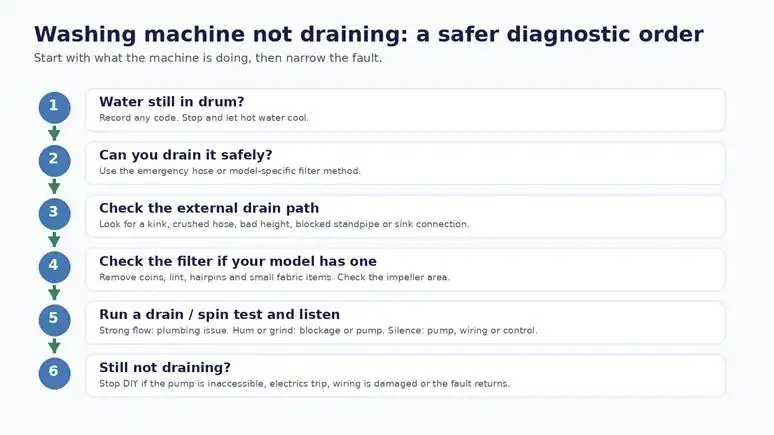
Figure 2. A safer diagnostic order keeps you from replacing the pump before ruling out the hose, filter and household drain.
1. Check the drain hose before you touch the pump
Manufacturers keep returning to the same point: drain hose installation matters. A hose can be kinked behind the washer, crushed when the machine is pushed back, inserted too far into a standpipe, sealed so tightly that air cannot enter, or routed at the wrong height. Any of those can create a slow drain, siphoning, backflow, or a no-drain error.
Do not use a universal measurement from a random video. The correct height and insertion depth vary by model. For example, current Samsung US guidance calls for 6 to 8 inches of insertion into a standpipe on the models covered by its guide, while Whirlpool and Maytag documentation for some machines limits insertion to about 4.5 inches. The manual for your washer wins.
- Pull the washer forward enough to see the entire accessible hose route. Look for a flattened bend where the cabinet or wall has trapped it.
- Check that the hose is not twisted internally by a tight cable tie or pushed so deep into the standpipe that drained water can siphon back.
- Do not tape or seal the hose airtight into a standpipe unless the installation manual explicitly says to do so. Several US manufacturers require an air gap.
- If the hose runs to a UK sink trap or waste spigot, remove the hose from the connection only after placing a bucket below it. Grease, lint and detergent residue can restrict the spigot even when the washer hose itself is clear.
- If freezing temperatures are possible in a garage, utility room or external drain run, consider a frozen hose. LG lists a frozen drain hose as a cause of OE/no-drain faults on affected models.
A useful isolation test: If the manual allows it, place the disconnected drain hose securely into a large bucket or suitable drain and run a drain or spin-only programme while you watch the flow. Bosch UK and LG both use versions of this test. Strong flow from the washer points towards the home waste connection. Weak or absent flow keeps the fault inside the washer or its hose. Secure the hose first because a working pump can empty water quickly.
2. Check the household drain, not just the washer
This is one of the easiest things to miss because the washing machine gets blamed for water it cannot push into a blocked drain. UK owners often find the restriction at the under-sink trap or the small spigot where the washer hose connects. In US installations, the standpipe or laundry sink can be partially blocked.
A recurring pattern in owner discussions is that the washer appears to have a bad pump until the hose is removed from the household connection. The machine then empties normally into a bucket. One DIYUK thread described an under-sink connection packed with accumulated fluff; clearing the waste connection restored normal drainage. That is not proof every no-drain fault is plumbing, but it is a valuable check before buying a pump.
3. Clean the pump filter if your model actually has an accessible one
On many front-loaders, the pump filter is the first component designed to catch what should never have left a pocket: coins, buttons, hairpins, lint, pet hair and small pieces of fabric. LG explicitly describes its front-loader filter as collecting lost buttons, loose change and lint. Samsung recommends regular cleaning on its front-load machines. Bosch UK tells owners to clean the pump housing so the impeller can rotate.
But do not assume every washer has a user-removable filter. Maytag notes that many newer top-loaders do not use a customer-cleanable drain filter, and Samsung states that its top-load models covered by the guide do not have the removable pump filter used on front-loaders. If you cannot find an access flap, stop hunting for one and check the manual.
1. Drain the washer first. Do not use the filter cap as the first uncontrolled drain point unless the manual tells you to.
2. Remove the filter and inspect the entire cage, not just the front face. Fine lint can pack into the slots.
3. Look into the housing with a torch. Remove visible debris that can be reached safely. Do not put fingers into a pump that is connected to power.
4. Check the impeller only as the manual allows. It may move in small magnetic steps rather than spin freely like a fan. What matters is whether something is visibly jammed, broken or loose.
5. Clean the sealing surface and reinstall the filter fully. A filter left cross-threaded or loose can create a leak on the next cycle.
Real-world clue: Small items can get past what looks like a clean filter. Repair-community threads repeatedly describe coins, small plastic pieces, socks and fragments of clothing lodged at the impeller, sump hose or pump inlet. If the filter is clean but the pump suddenly started grinding after a load with small items, a deeper obstruction is still plausible.
4. Listen to the pump instead of guessing
The noise during a drain command is diagnostic. It is not perfect, but it is more useful than replacing parts by instinct.
| Sound / behaviour | What it can mean | What to do next |
| Normal pump sound and strong water flow | The washer is probably pumping correctly | Inspect the household drain, hose installation and backflow |
| Steady hum but little or no water | Pump motor is energised but water is restricted, the impeller is jammed, or the pump is mechanically weak | Recheck filter, hose and impeller area before condemning the pump |
| Grinding or rattling during drain | Foreign object contacting the impeller, damaged impeller or failing pump | Stop repeated tests; inspect the drain path and pump area |
| Pump starts, stops, then works again after cooling | Intermittent obstruction, overheating pump or electrical/control issue | Avoid assuming a reset fixed it; arrange diagnosis if the fault repeats |
| No pump sound at all | Pump may not be receiving power, pump winding may be open, or the control is not commanding drain | Use error codes/model diagnostics; internal electrical testing is a technician-level step |
LG uses a similar listening test in current OE troubleshooting: run a spin-only cycle and listen for the drain pump during the first part of the test. A hum tells you the motor is at least being energised. It does not prove that the pump can move water under load, and it does not prove the impeller is intact.
5. Too many suds can look like a drain fault
A washer full of foam can confuse the diagnosis. LG notes that excessive suds can create air pockets so the pump starts drawing air instead of water and the machine can report a drain error. Whirlpool also lists excessive suds as a cause of delayed draining on some front-load models.
If you used too much detergent, the wrong detergent for an HE machine, or added a concentrated product without adjusting the dose, do not immediately keep adding rinse cycles with more detergent. Once the machine can drain safely, follow the manufacturer procedure for clearing suds and reduce the dose on the next load.
6. When a clean filter still does not solve it
A clean filter rules out only the debris you can see there. Water still has to travel from the tub through a sump hose, into the pump housing, through the pump and out through the drain hose. A sock or fabric fragment can lodge in the sump hose. A coin can reach the impeller. The impeller can crack or loosen on its shaft. The pump motor can hum without developing useful flow.
This is where many owner threads go wrong: the filter is clean, so the pump is ordered. Sometimes that fixes it. Sometimes the new pump behaves exactly like the old one because the real blockage is in the hose or plumbing, or the pump is not receiving the correct command. If the filter, external hose and household drain are clear, use model-specific service information or a qualified repairer rather than replacing parts at random.
A simple way to separate blockage, pump and plumbing faults
| Test result | Most useful interpretation |
| Washer drains strongly with its hose in a bucket | Pump and internal path can move water. Investigate the normal household drain connection and hose installation. |
| Pump hums but flow is only a trickle even with hose free | Restriction remains in the washer/hose, or the pump is mechanically weak. |
| No flow and grinding noise | Stop repeated operation. Check for a foreign object or damaged pump/impeller. |
| No sound, no flow, code returns | Pump power/control or pump motor fault becomes more likely. Internal electrical diagnosis is appropriate. |
| Water drains but returns later | Backflow, siphoning or a household drain problem is more likely than a pump that cannot drain. |
Front-loader and top-loader differences that matter
Front-loaders are easier to describe generically because many have a lower access flap with an emergency drain hose and pump filter. Even then, the details vary. Some filters are behind a kick panel or drawer, and some are not intended for routine owner access.
Top-loaders vary more. Many modern designs do not provide a removable front pump filter. A no-drain fault can involve the drain hose, lid sensing, pump or internal tub-to-pump hose. If the drain system is inaccessible without removing the cabinet or tipping the washer, that is the point to switch from a general guide to the service information for the exact model.
US and UK drain setups: the small details are different
The fault-finding logic is the same in both markets, but the installation details are not. US washers commonly drain into a standpipe or laundry tub. UK front-loaders are often connected to an under-sink waste spigot or a standpipe. That changes where restrictions and backflow show up.
- US: verify standpipe height and insertion depth against the specific installation manual. Do not assume another brand’s measurements apply.
- UK: inspect the under-sink trap or spigot if the hose connects there. Hotpoint specifically tells owners to check for food, fat or other blockage where the washer empties into the sink waste.
- Both: keep the hose free of kinks and crushing, and make sure the drain arrangement does not create unintended siphoning or backflow.
- Both: if moving the hose changes the symptom, treat that as evidence. A pump that empties strongly into a safe temporary drain has already told you something useful.
Common drain-related error codes
Codes vary by model and region, so use the code only as a direction, then confirm it in the manual for the exact model.
| Brand / family | Examples | What current manufacturer guidance associates with it |
| LG front-loaders | OE; some current LG lists also include E03/E21 | Unable to drain. Check drain hose, pump filter and pump operation. |
| Samsung | 5C, 5E, nd and related no-drain variants | Water is not draining at the expected rate or at all. |
| Whirlpool / Maytag | F9E1; DRN on some models | Long or abnormal drain. Check hose installation and pump filter where fitted. |
| Hotpoint UK | F05 | Waste pipe blockage or pump issue; water may remain and the door may stay locked. |
| Bosch UK | E18 | Current Bosch UK guidance points owners to pump/filter blockage and drain-hose checks. |
FixDecoded tool: Error Code Decoder can help you start from the code, but your model manual remains the final authority.
What repair communities add to the manufacturer checklist
Manufacturer support pages are intentionally conservative. Owner and technician communities are useful for showing the awkward faults that appear after the obvious checks. Across appliance-repair and DIY discussions, several patterns recur:
- A clean filter does not guarantee a clear drain path. Small objects can lodge behind the filter, at the impeller, in the sump hose or where the drain hose meets the home waste.
- Intermittent draining deserves attention. A machine that drains after sitting for a while may have a partial obstruction or a pump that is failing when hot. “It worked after a reset” is not the same as “the cause is fixed”.
- A new pump does not fix a blocked standpipe. Community threads include owners who replaced parts before discovering a restriction outside the appliance.
- Grinding before a complete no-drain failure is a useful clue. It can indicate debris contacting the impeller or a pump that is mechanically deteriorating.
- Loads containing socks, bra inserts, pet-hair-heavy fabrics, bath mats or pocket debris are common starting points for sudden drain trouble. The timing of the first failure can be diagnostically useful.
Community reports are not a substitute for model documentation, and unsafe advice should be ignored. In particular, some forum posts suggest powering a detached pump directly from household mains to test it. That is not an appropriate homeowner test. A live-mains bench test exposes bare terminals and can cause electric shock.
What not to do when the washer will not drain
- Do not force the door open while water is still inside.
- Do not unscrew a pump filter from a full, hot drum without a controlled way to catch the water.
- Do not keep restarting the same drain cycle if the pump is grinding. Repeated running can turn a small obstruction into pump damage.
- Do not shove a screwdriver, drain snake or rigid wire blindly into an attached washer hose. You can puncture the hose or damage internal parts.
- Do not bypass lid or door interlocks.
- Do not replace the pump only because you can hear a hum. A jammed impeller or blocked hose can produce the same clue.
- Do not use standpipe height or hose insertion numbers from another model as if they are universal.
When the drain pump really is the leading suspect
After the filter, hose and household drain are clear, the pump moves up the list if it grinds, repeatedly stalls, has a visibly damaged impeller, stays silent despite a confirmed drain command, or produces very weak flow through an unrestricted hose. Pump replacement can be straightforward on some machines and a major strip-down on others.
At that point, the exact model number matters more than any generic guide. The safe next step is model-specific service information or a qualified appliance engineer, especially where reaching the pump requires cabinet removal, tipping a heavy appliance, disconnecting wiring, or working near mains components.
Test the repair before pushing the washer back
1. Reassemble the filter, emergency hose cap and drain connection fully.
2. Pour or add only the amount of water the manufacturer recommends for a drain test, or run the model’s drain/spin test programme.
3. Watch the filter housing, hose connections and under-sink/standpipe connection for leaks.
4. Confirm that the water leaves quickly and does not flow back into the drum.
5. Run a small normal load before a heavy load. If the fault returns only under certain loads, note what is different rather than immediately repeating repairs.
Frequently asked questions
Why is my washing machine full of water but the pump is humming?
A humming pump is being energised, but it may be unable to move water because the filter, sump hose or drain hose is blocked, the impeller is jammed, or the pump is mechanically weak. Clear the accessible drain path before treating the hum as proof the pump itself has failed.
Can a washing machine fail to spin because it will not drain?
Yes. Many machines will not enter a normal high-speed spin while they still detect water. That is why a drain fault often looks like a spin fault.
Why does my washer drain into a bucket but not the standpipe or sink?
That strongly suggests the washer can pump water and the restriction is in the normal waste connection, standpipe, sink trap or hose arrangement. Reconnect everything according to the installation manual after clearing the plumbing.
Why is my washing machine not draining after I cleaned the filter?
The blockage may be elsewhere, the drain hose may be kinked, the household drain may be restricted, the pump impeller may be damaged, or the pump may not be operating correctly. A clean filter narrows the diagnosis but does not finish it.
Should the pump impeller spin freely by hand?
Not necessarily. Some small magnetic pump motors feel stepped or notchy. Look for a visible obstruction, broken blades, excessive looseness or binding, and follow model-specific guidance rather than judging the pump only by how freely it spins.
Can too much detergent stop a washer draining?
Excessive suds can interfere with drainage on some machines. LG and Whirlpool both document suds as a factor in drain-related problems on affected models. Use the detergent type and dose specified for the washer and water conditions.
Is a no-drain fault safe to keep resetting?
One restart after correcting an obvious hose or filter issue can be useful. Repeatedly resetting a washer that grinds, overheats, trips power or repeatedly returns the same drain code hides the symptom rather than repairing the cause.
The bottom line
A washing machine that will not drain does not automatically need a new pump. Work from the outside in: make the standing water safe, inspect the drain hose and household waste, clean the filter if the model provides one, then use the pump sound and actual water flow to decide whether the restriction is still in the water path or the pump itself is failing. The fastest diagnosis is usually the one that proves each section of the drain path before a part is ordered.
Sources and verification
• Samsung US: Washing machine will not drain
• Samsung US: Washing machine information and error codes
• LG USA: Water Not Draining (OE Error)
• LG USA: Front Load Washer OE Error Code
• LG USA: How to Clean the Drain Pump Filter
• Whirlpool: Why Is My Washing Machine Not Draining?
• Whirlpool Product Help: F9 E1 Front Load Washer
• Maytag: How to Drain a Washing Machine
• Maytag: How to Find and Clean a Washing Machine Filter
• Bosch UK: Washing machine is not draining
• Bosch UK: E18 washing machine error
• Hotpoint UK: Washing machine troubleshooting
• Reddit r/DIYUK: Washing machine not draining discussion
• Reddit r/appliancerepair: recurring washer service-call patterns