
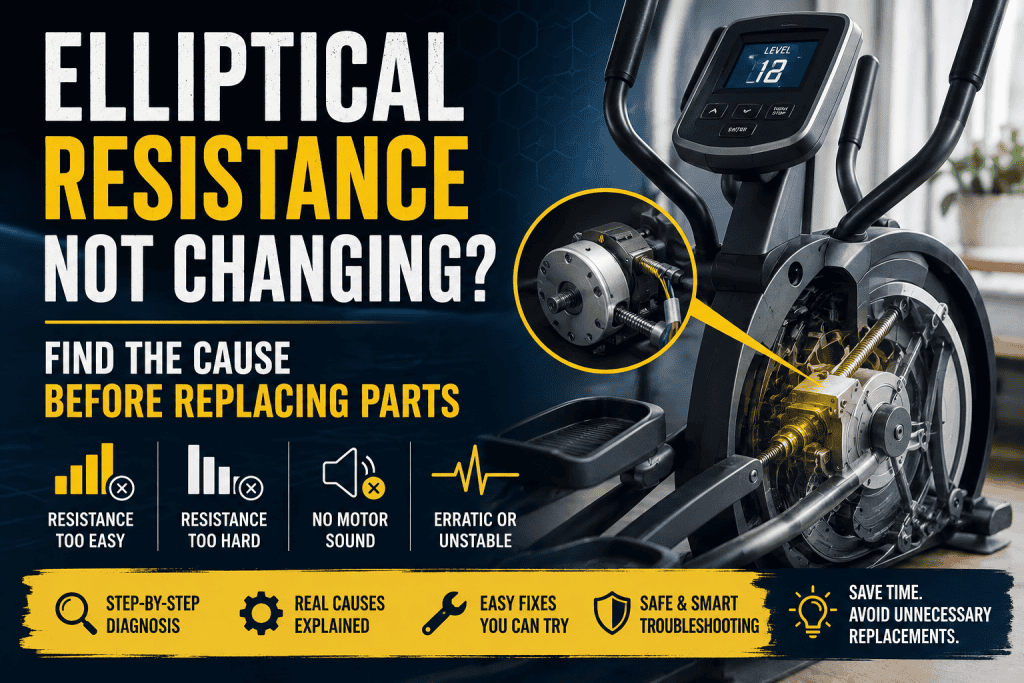
An elliptical can look perfectly healthy while its resistance system is doing almost nothing. The display lights up, the workout timer runs, and the resistance number climbs from 1 to 10 or 20. At your feet, though, the effort barely changes. On another machine the opposite happens: level 1 suddenly feels like a hill climb, or the resistance moves up but refuses to come back down.
Those symptoms are often blamed on the resistance motor. Sometimes that motor is the failed part. Just as often, the motor is doing exactly what it has been told to do while a cable, brake mechanism, position sensor, power supply or wiring connection is the real problem.
The useful diagnosis starts before any cover comes off. First decide whether the console is accepting the command, whether the machine makes any response to that command, and whether the physical effort changes with it.
If more than the resistance is misbehaving, start with the broader Elliptical Troubleshooting: Diagnose Common Problems by Symptom. It separates resistance faults from console, sensor, pedal, noise and incline problems before you go deeper.
In this guide 19 sections
The most important distinction: display level versus actual pedal load
Press the resistance control once or twice while pedalling slowly and safely. Watch the display, listen to the machine and notice what changes at your feet. You are not trying to prove a part has failed. You are finding out how far the command travels through the machine.
If the resistance number on the display does not change at all, the problem starts higher in the chain. The keypad, console software, workout mode or upper control electronics may not be accepting the command. If the number changes normally but the pedal load does not, the console has at least registered the request and the investigation moves downstream.
That simple separation is more useful than ordering a motor because a search result says resistance problems are usually motor problems.
| What you observe | What it makes more relevant |
| Display level does not change | Keypad or console input, programme state, software, upper-control fault |
| Display changes, no sound and no physical change | Power to the resistance system, cable or harness, resistance motor or servo, lower electronics |
| Display changes and a motor whirs, but effort does not | Mechanical linkage, cable, servo gearing, magnetic brake travel or attachment |
| Resistance changes only in one direction | Motor or servo feedback, zero or position sensing, wiring, mechanical binding |
| Resistance hunts up and down or will not settle | Position feedback, zero switch, potentiometer or encoder, cable connection, servo control |
| Level 1 is much too hard | Brake or magnet assembly not returning, incorrect cable position, calibration or other mechanical drag |
| Highest level still feels easy | Brake or magnet assembly not moving towards the flywheel, disconnected cable or linkage, motor travel or control problem |
| Resistance feels wrong only after the machine warms up | Intermittent electrical or mechanical fault, but first confirm that the perceived change is real and repeatable |
How the resistance system actually creates load
There is no single resistance mechanism inside every elliptical. That matters because a repair that makes sense on one machine can be nonsense on another.
Many modern home ellipticals use a magnetic brake. Magnets sit near a metal flywheel and the machine changes their position to alter braking force. Horizon’s current support material describes the magnets moving closer to or farther from the flywheel, with no direct contact between the magnetic brake and flywheel. A small motor or servo may move that magnet assembly through a cable or linkage.
Cheaper or manually controlled machines can use a tension knob and cable rather than an electronic command. Sunny Health’s assembly guidance is a good example: the resistance knob changes cable length, and the cable must be correctly hooked into the lower tension mechanism. A disconnected or badly routed cable can leave the knob turning while the actual brake barely moves.
Commercial ellipticals can be different again. Some self-powered units use generator or alternator-based resistance rather than the small motor-and-magnet arrangement found in many home machines. Precor currently sells both externally powered and self-powered EFX configurations. That is why the exact model matters before anyone tells you which component to buy.
A changing number on the console proves less than it seems
When the displayed resistance level changes, it is tempting to declare the console healthy. More precisely, the display has shown that it accepted an input. It has not proved that the lower electronics received the command, that power reached the resistance motor, that the motor travelled correctly, or that the brake mechanism moved with it.
Johnson Health service documentation makes this distinction very clearly. A damaged console cable can leave the resistance value changing on screen while the motor does not move. The same symptom can also occur when the motor-drive circuit or the resistance motor itself is not responding.
This is also why a console should not be the first expensive part replaced simply because the machine has an electronic resistance fault. There are several links between the button and the brake.
Listen for the resistance motor, but do not overinterpret the sound
On an electronically adjusted magnetic system, changing resistance often produces a brief whir, hum or small movement from inside the shroud. That sound is useful evidence. It is not a complete diagnosis.
If there is no sound at all while the display level changes, the resistance motor may not be receiving power or may have failed. A loose harness or lower-control fault can produce the same silence.
If you hear the motor every time but the pedal load never changes, the motor may be turning without moving the brake correctly. A cable can be detached, a linkage can slip, a gear inside a servo can fail, or the magnetic assembly can bind. Real owner reports often describe exactly this pattern: a motor can be heard cycling even though the resistance at the pedals is wrong. Those reports are useful because they show why sound alone should not be translated into ‘the motor is good’.
Repeated clicking or a motor that runs for much longer than normal can be another clue. Some programmable systems use a zero switch or position feedback so the motor knows where its travel begins and ends. If that feedback is lost, the system can hunt for position instead of settling cleanly.
When the resistance is stuck on the easiest setting
A machine that remains easy at every selected level is usually failing to create enough braking force. On a motorised magnetic system, the magnet assembly may not be moving closer to the flywheel. The servo may not move, its cable may be disconnected, or the linkage between the motor and brake may have failed.
On a manual resistance elliptical, inspect the resistance knob and cable arrangement described in the owner’s manual. If the knob suddenly became loose after assembly or transport, a cable that was never hooked correctly deserves attention before anything electronic. Sunny Health’s tension-system instructions show how dependent some manual designs are on the upper and lower cable being physically joined correctly.
Do not assume ‘easy resistance’ automatically means the drive belt is loose. A drive belt that slips can make the stride feel wrong, especially under load, but it is a different mechanical problem from a resistance command that does not alter braking. If the machine makes a slipping or jerking sensation rather than a smooth but easy stride, the broader elliptical troubleshooting path is more appropriate.
When level 1 is already far too hard
A permanently heavy elliptical can be more confusing because the resistance system may appear to be working in reverse. The brake or magnets may be sitting too close to the flywheel at their lowest commanded position, a tension cable may be set incorrectly, or the servo may have lost its zero position.
Johnson service documentation specifically lists an incorrectly positioned magnetic brake as a cause of resistance that is too hard or too weak. Other service material describes zero-switch and feedback faults that can stop a programmable motor from returning to its correct home position.
There is one important reality check before diagnosing a fault: resistance numbers are not standardised between brands. NordicTrack’s current consumer guidance explicitly notes that resistance levels are arbitrary and not directly comparable between devices. If you bought a used elliptical and level 5 feels much harder than level 5 at your gym, that comparison alone does not prove the machine is broken.
What matters is whether the same machine has changed, or whether moving from its own lowest to highest setting produces a meaningful, repeatable difference.
Resistance that changes up but not down, or down but not up
One-direction behaviour is a valuable clue because the resistance system is not completely dead. The motor has demonstrated some ability to move, and at least part of the command path is functioning.
Programmable resistance systems often use separate motor-drive states for increasing and decreasing resistance, plus feedback that tells the controller where the motor is. Johnson’s cable and voltage charts show that a broken command or feedback conductor can produce behaviour where the motor moves in one direction but does not return or zero correctly.
At owner level, the useful job is to record the pattern rather than probe the cable. Does resistance increase normally and then refuse to decrease? Does pressing down make the motor stop, click or continue running? Does restarting the machine return it to an easier level? That information can separate a directional control or feedback fault from a completely failed motor when a technician tests the system.
Do not reverse motor wires or apply external voltage to make the mechanism move. A service procedure may use powered tests, but those are not generic DIY steps.
Why the resistance can keep hunting or changing by itself
Erratic resistance is different from no resistance. The machine is changing load, but it is not holding the position requested. That can happen when the controller cannot reliably determine the motor position.
Older Johnson programmable systems use position-related feedback such as a zero switch and motor count. Other equipment can use a potentiometer, encoder or different feedback arrangement. If the feedback becomes intermittent, the controller may keep correcting a position that it thinks is wrong. The result can be resistance that cycles, hunts, overshoots or settles at inconsistent levels.
A loose connector can create similar behaviour because the feedback disappears only when the frame moves. This is one reason a fault that started immediately after moving or assembling an elliptical should put pinched and partially seated cables high on the list.
Software can also affect resistance behaviour on connected machines, particularly when automatic workouts control resistance. Before treating an automatic change as a hardware failure, switch to the model’s normal manual workout and check whether direct resistance commands behave consistently.
Manual mode is the cleanest way to separate a workout feature from a fault
Connected ellipticals can change resistance automatically during trainer-led, interval or adaptive workouts. That is normal behaviour if the programme is controlling the machine.
For diagnosis, use the normal manual mode described by the manufacturer. Choose a comfortable cadence and compare the low and high ends of the machine’s own resistance range. You do not need to sprint or push against a dangerously heavy setting. You are looking for a clear physical difference that follows the command.
If manual resistance works properly but an automatic workout does not, the physical brake system has already proved that it can change load. The investigation moves towards the workout software, connection, account or programme state rather than immediately towards the resistance motor.
Do not confuse resistance with incline
Ellipticals that have an adjustable ramp can change the workout in two different ways. Resistance changes how hard the drive system pushes back. Incline or ramp angle changes the movement path and muscle emphasis. A steeper ramp can make a workout feel harder even if the resistance level has not changed.
That becomes important when one function works and the other does not. If incline moves normally while resistance is dead, the console and some shared electronics are clearly still alive, but the resistance branch can still have its own motor, wiring or control fault. If neither incline nor resistance responds while the console remains on, a shared cable or lower-control problem becomes more plausible than two independent motors failing at exactly the same moment.
The exact architecture varies, so use that observation as a clue, not a universal circuit diagram.
A wrong power adapter can create a very convincing resistance fault
Some home ellipticals rely on an external low-voltage adapter. A console may still illuminate even when the supply is incorrect or weak enough that a motorised resistance system cannot operate normally. Johnson resistance troubleshooting includes a failed or improper power supply among the possible causes of no or erratic resistance change.
Check the label and manual for the exact adapter specification. Do not assume that a plug which physically fits is electrically correct. If the resistance problem appeared after the original adapter was lost or replaced, the power supply should move much higher in the diagnosis.
The owner-level check is identification, not live measurement. Verify that the adapter is the correct manufacturer-approved specification, inspect it for obvious damage, and use a known working outlet. Voltage testing of internal cables or powered boards belongs with someone trained to follow the service documentation.
Second-hand ellipticals deserve an assembly check before a parts order
Resistance faults often appear after a machine has been dismantled, moved downstairs, transported in a van or rebuilt in another room. That timing is useful. Cables run through console masts and frame sections where they can be pinched, stretched or left partially connected. Manual tension cables can also be assembled incorrectly.
If the machine worked before the move and failed immediately afterwards, a simultaneous electronic component failure is possible but less persuasive than a disturbed connection until proven otherwise. Switch off and disconnect the machine, then inspect only the connectors and cable routing the owner’s assembly instructions make accessible.
Do not pull on a harness to ‘see if it is loose’. Look for a connector that is not fully seated, insulation trapped under a bolt, a cable stretched across a moving joint, or a manual tension cable that was not hooked according to the assembly instructions.
What a technician can prove that symptom-watching cannot
Eventually the diagnosis reaches a point where the next useful question is electrical: did the resistance motor receive the correct command and power, and did its position feedback return correctly?
Manufacturer service procedures answer that with controlled measurements at the console cable, motor circuit and feedback sensors. Johnson documentation, for example, publishes expected behaviour for resistance-up, resistance-down, motor power and zero-position circuits. Those values are useful to a trained technician because they separate an open harness from a failed motor or console. They are not a reason to turn a powered elliptical into a casual multimeter project.
A technician can also watch the brake mechanism through the specified service procedure and determine whether the motor travels but the magnets or cable fail to follow. On self-powered commercial machines, diagnosis can involve generator or alternator loading rather than the small servo logic of a residential elliptical.
That is why the best owner diagnosis is a precise symptom description, not a voltage reading copied from a different model.
When replacing the resistance motor actually makes sense
A resistance motor becomes a strong suspect when the model is known to use one, the console registers commands, the correct power arrangement has been confirmed, accessible wiring is intact, and service testing shows that the motor receives the command but does not move correctly.
The opposite is equally important. Replacing the motor is weak reasoning when the display does not accept resistance commands, the machine is using the wrong adapter, a manual cable is disconnected, the servo is audibly moving but the brake does not follow, or the system cannot find its position because feedback is missing.
Parts should be ordered by the exact model and serial or product code. Ellipticals that look almost identical can use different motors, cable lengths, gear ratios and console logic. A visually similar motor is not automatically compatible.
A simple diagnostic story to take to support
Before contacting the manufacturer or a repair technician, write down what the machine does rather than what you think has failed. Note the exact model and serial number, whether the resistance value changes on the display, whether you hear a motor when changing levels, whether the physical effort changes at all, and whether resistance can move in both directions.
Add when the fault started. Was it after transport, assembly, a power-adapter replacement or a software update? Does the resistance work correctly in manual mode but not in an automatic workout? Is the machine stuck easy, stuck hard or hunting between levels?
Those details give support a much shorter path to the correct service procedure and make it less likely that the first response will be a generic reset or an unnecessary parts order.
When to stop using the elliptical
Stop the workout if resistance changes unpredictably enough to affect balance, the pedals suddenly become much harder to move, a motor or wiring area smells hot, there is smoke or arcing, an adapter or plug becomes unusually hot, the machine grinds or binds, or a linkage moves unpredictably under load.
Also stop when the next useful step requires operating the elliptical with protective covers removed, testing live electronics, applying power directly to a motor, or reaching into a moving brake or flywheel mechanism. Those steps belong to the service procedure, not to ordinary owner troubleshooting.
The useful question is not whether the resistance motor is bad
When elliptical resistance is not changing, start with the command and work towards the brake. Does the display level move? Does the resistance system make a sound? Does the pedal load actually change? Can the system move both up and down? Did the fault begin after a move, a new adapter or an automatic workout?
Those observations separate problems that feel identical at first. A dead motor, a pinched console cable, a disconnected manual tension cable, a brake stuck in the wrong position and a lost position-feedback signal can all leave you saying, ‘the resistance does not work’. They do not have the same fix.
The goal is to identify where the command stops becoming physical resistance before replacing anything expensive.
Related FixDecoded guide
For problems outside the resistance system, return to Elliptical Troubleshooting: Diagnose Common Problems by Symptom. That cornerstone covers console power, RPM and speed sensing, noises, pedal motion, incline and error-code diagnosis.
Sources
• Horizon Fitness: Elliptical Resistance, Magnetic and Electronic – Current manufacturer explanation of magnetic resistance and magnet-to-flywheel movement.
• Horizon Fitness: Elliptical Troubleshooting – Current manufacturer troubleshooting index, including incorrect resistance and related console or sensor faults.
• Johnson Health Tech: Resistance Troubleshooting – Manufacturer service flow covering no change, erratic resistance, excessive or weak resistance, tension cable, power supply, console cable, servo motor and magnetic brake position.
• Johnson Health Tech: Console Cable Troubleshooting for Bike and Elliptical – Service documentation showing how cable and feedback faults can produce normal display changes with no motor movement, one-direction faults or failure to zero.
• Johnson Health Tech: Elliptical and Bike Resistance Motor Voltage Checks – Technical validation of motor command, position-feedback and zero-switch fault patterns. Used for technician-level context only.
• Sunny Health & Fitness: Elliptical Tension System Assembly – Manufacturer example of manual resistance systems that depend on a correctly connected tension cable.
• Sunny Health & Fitness: Elliptical Troubleshooting – Current model-specific support showing the range of magnetic and electro-magnetic elliptical designs and repair paths.
• NordicTrack: Elliptical Resistance Levels – Current manufacturer guidance confirming that resistance levels are arbitrary and generally not comparable between devices.
• Precor: EFX 800 Line Specifications – Manufacturer example showing powered and self-powered commercial elliptical configurations, reinforcing that resistance architecture is model-specific.
• Precor: Preventative Maintenance – Manufacturer maintenance context for elliptical wiring, drive belts, pulleys, ramps, wheels and resistance range.