
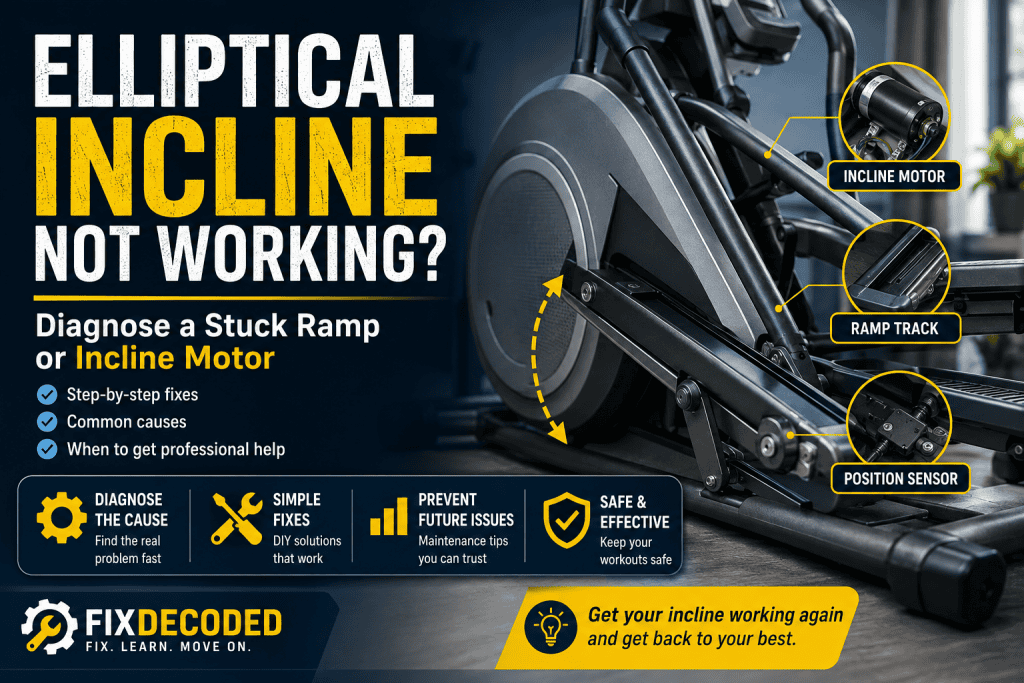
When an elliptical incline stops moving, it is tempting to call the incline motor bad and order one. That is one possible cause, but it is not the only one. The console may be failing to send the command, the ramp may be physically blocked, a cable may have shifted during assembly, the machine may have lost its position reference, or the lift mechanism may be trying to move and failing under load.
If your elliptical incline is not working, the fastest route is to watch what still happens when you press the incline controls. Does the displayed level change? Do you hear a motor or relay? Does the ramp move a little and stop? Will it go up but not down? Does the fault appear only after several incline changes? Each pattern points to a different part of the system.
There is one check to make before any of that: confirm what kind of incline your machine actually has. Some ellipticals use a powered ramp, some have a manually adjustable ramp, and some have no incline adjustment at all. Product families can include more than one of these designs. A console reset cannot move a ramp that was designed to be adjusted by hand.
Safety first: Switch the elliptical off and unplug it before inspecting accessible wiring, ramp paths or hardware. Do not put hands beneath a raised ramp, force a powered actuator by hand, bypass limit or home switches, or run the machine with protective covers removed. A raised ramp can move unexpectedly and powered drive parts can cause serious injury.
If incline is only one of several faults, start with the elliptical troubleshooting guide to separate power, console, resistance, motion and incline symptoms before going deeper.
In this guide 18 sections
First, identify the kind of incline system you have
Look at the owner manual or the product specification before troubleshooting. A powered incline usually has console buttons that command a motor or actuator to raise and lower a ramp or change the geometry of the stride. A manual incline normally uses a pin, handle, adjustment bar or fixed positions that you set while off the machine. A fixed-ramp model has nothing to calibrate or drive.
This sounds obvious, but product families can be confusing. A model name may be shared across generations, and one version can have powered incline while another does not. Use the full model and, where available, the product revision or serial number. The exact manual should take priority over a generic reset sequence found online.
The quickest way to narrow an incline fault
| What you observe | Where to look first |
| Incline number changes, ramp stays still | Command is being registered. Check calibration, wiring, actuator or motor, mechanical binding and control output. |
| Incline buttons do nothing on the display | Console control, keypad, software state or communication becomes more relevant. |
| Motor hums, clicks or starts, but ramp does not move | Mechanical bind, actuator screw or gearing, linkage, or a motor that cannot develop movement under load. |
| Ramp moves a little and stops | Obstruction, binding, position feedback, thermal protection or a weak/failing actuator. |
| Ramp goes up but will not come down, or the reverse | Directional control, wiring, feedback or limit logic. Do not assume the whole motor is dead. |
| Ramp moves, but displayed incline is wrong | Calibration or position feedback becomes more likely. |
| Incline works cold, then stops after repeated changes | Thermal protection or a fault that appears as the motor warms. |
| Ramp is stuck high after power-up or calibration | The system may not be completing its home or position-reference routine. |
| Incline failed immediately after moving or assembly | Cable routing, connectors, trapped wiring, alignment or assembly order deserve attention. |
Six checks before you go deeper
- Confirm the exact model and whether the incline is powered, manual or fixed.
- Remove anything that could obstruct the ramp, pedals or moving incline structure.
- Press an incline control once and note whether the display changes, whether you hear the motor, and whether the ramp moves at all.
- Power the machine down and inspect only accessible connectors and cables for looseness, pinching or damage, following the owner manual.
- Use the model-specific calibration procedure only if the manufacturer provides one for that machine.
- Stop if the ramp binds hard, drops, twists, makes severe grinding noises, exposes damaged wiring or will not support the pedals correctly.
Calibration can fix position errors, not broken hardware
Calibration is useful when the incline mechanism can move but the machine no longer agrees with itself about where the ramp is. Some systems travel through their range so the controller can learn or confirm the reference positions. The Schwinn 490 service procedure, for example, has the machine move through its incline range and save calibration values before the unit is checked again at its minimum and maximum settings.
That is very different from using calibration as a universal reset. If a wire is disconnected, an actuator is stripped, the ramp is jammed or the controller is not driving the motor, calibration may fail because the underlying fault is still there. Repeating it over and over can also keep loading a motor that is already struggling.
Run only the calibration procedure written for your exact model. Button combinations and service menus are not standard across brands or even across generations of the same brand. If the ramp cannot move freely, or the calibration repeatedly starts and stalls, stop treating the procedure itself as the fix.
If the display changes but the elliptical ramp is not moving
This is one of the most useful patterns. The console has at least recognised your button press and updated the requested incline. That does not prove every communication stage is healthy, but it moves attention downstream from the button itself.
With the elliptical switched off and unplugged, check only the connectors that the owner manual makes accessible. Look for a plug that is not fully seated, a cable pinched during assembly, insulation damaged by a cover, or a harness pulled tight around a moving joint. If the problem appeared immediately after the machine was assembled or moved, this check becomes more important.
On a powered-incline elliptical, the lift system is a separate electromechanical mechanism rather than simply a console setting. Replacement and internal testing are model-specific tasks, so a dead ramp is not a reason to open the machine before the simpler checks are finished.
If the incline motor makes noise but the ramp stays put
A hum, click or brief motor sound tells you something tried to happen. It does not tell you that the motor is healthy. The actuator may be receiving a command but be unable to move because the ramp is jammed, a linkage has failed, internal gearing is damaged, the threaded drive is binding, or the motor is no longer strong enough to move the mechanism.
Do not put a hand under the ramp while somebody presses the incline button. Do not remove the actuator bolt to ‘free’ a raised ramp unless the manufacturer’s service procedure specifically tells you how to support the structure first. Some incline assemblies carry the weight of a ramp or pedal path, and releasing the wrong fastener can let that structure drop.
Look instead for external evidence that does not require powered exposure: a foreign object in an accessible ramp path, a visibly bent bracket, a loose attachment point, or a component sitting at an angle that does not match the opposite side. If the motor can be heard repeatedly but there is no movement, that is a good point to stop owner-level testing and arrange model-specific service.
If the elliptical incline is stuck at the top or bottom
A ramp that stops at one end of its travel and refuses to return can be a mechanical problem, but it can also be a position-reference problem. Powered incline systems need some way to know where they are. Depending on the design, that can involve a home switch, limit switch, position sensor, counted motor movement or other feedback.
Life Fitness service material illustrates why this distinction matters. Its incline-related error documentation lists home or decline switch faults, loose or damaged cables, controller faults, incline motor faults and thermal protection among possible causes when the system cannot confirm the expected position. The exact architecture differs by machine, but the diagnostic lesson is broader: a stuck ramp does not automatically mean the motor itself is open-circuit or dead.
If your console shows an error code, record it exactly before resetting anything. Search the manual or the manufacturer’s support site using both the code and the full model number. A code that refers to position feedback changes the fault path completely compared with a dead incline button.
If the incline goes up but will not come down
One-direction movement is a particularly useful clue because the mechanism has already proved that it can move. The failure may sit in the command for one direction, its wiring, feedback or limit logic, or in the actuator itself. On some designs, up and down are driven through different control paths even though they use the same motor assembly.
Do not reverse wires, bridge contacts or apply external voltage to the incline motor as a home test. Service manuals may describe voltage checks or connector tests for trained technicians, but those procedures can expose mains voltage and moving mechanisms. For an owner-level diagnosis, the safe observations are whether the display responds, whether there is sound, whether movement starts, and whether an error is reported.
If the ramp can move one way but is now trapped at an uncomfortable or unsafe height, stop using the machine until the fault is corrected. A workout is not the place to discover that the ramp cannot return when your stride changes.
If the ramp moves but the incline number is wrong
When the physical ramp moves normally but the displayed level is clearly wrong, calibration and position feedback deserve more attention than the motor. The controller may be moving the actuator but using an incorrect reference for where the mechanism is.
This is the situation where a manufacturer calibration routine makes the most sense, provided the machine can travel freely and the manual tells you to perform it. Note the start position, the level shown on the console and where the ramp actually finishes. If calibration completes but the reported position remains wrong, the feedback system may need service rather than another reset.
If incline stops working after several changes
An incline system that works at the start of a session and then refuses further movement adds heat and duty cycle to the diagnosis. Lift motors are not always designed for continuous back-and-forth operation. Some equipment protects the incline motor when it becomes too hot.
Life Fitness incline-related service information includes thermal protection as a possible cause of an inoperative lift system, and Schwinn documentation for its motorised-incline elliptical also includes service handling for incline operation and calibration. If the fault consistently appears only after repeated incline changes and later clears after cooling, write down that timing rather than immediately replacing a part.
Thermal protection is not permission to keep forcing the controls. Let the machine cool and follow the manufacturer guidance. If normal use repeatedly triggers the same protection, the motor may be overloaded by binding, misalignment or an electrical fault that needs attention.
Check the ramp path for binding before blaming the electronics
The incline motor has to move real weight through a mechanical path. Dirt, a displaced cover, an object beneath the mechanism, a damaged roller or a distorted bracket can turn an electrical-looking fault into a simple mechanical obstruction.
Inspect only what is visible and safe with the power disconnected. Compare the left and right sides of the ramp or lift frame where the design allows it. Look for fresh scrape marks, plastic that has shifted into the travel path, a cable caught where it should not be, or an object that could prevent movement. Do not spray lubricant on the mechanism unless the manual identifies a lubrication point and specifies the product to use.
Precor’s maintenance guidance for adjustable-ramp ellipticals includes checking ramp and wheel movement and, in its commercial service schedule, lubrication of the lift-motor screw where required. That is not a universal instruction for every home elliptical. It is an example of why the exact maintenance specification matters more than a generic ‘lubricate the incline’ tip.
If the problem began after assembly, moving or service
A fault that starts immediately after the machine was moved or assembled deserves a different first question from a fault that developed after years of use. Connectors can be left partly seated, harnesses can be routed too tightly, covers can trap wires, and structural fasteners can pull an incline assembly out of alignment if the assembly sequence is ignored.
Horizon instructs users assembling the 7.0 AE to put all nuts and bolts in place and partially thread them before fully tightening any one bolt. That helps the structure settle into alignment before final tightening. If an incline fault started on day one, go back through the model-specific assembly steps rather than immediately treating the motor as defective.
If the problem appeared immediately after professional service, contact the provider before dismantling anything yourself. The timing is useful evidence, and opening the machine may complicate warranty or service responsibility.
Do not confuse incline failure with resistance failure
Incline changes the ramp angle or stride geometry. Resistance changes how hard it is to move the pedals. The two can be programmed together, so it is easy to describe both as the machine ‘not getting harder’, but they are different systems.
Watch the ramp while changing incline, then change resistance separately. If the ramp moves but pedal effort does not change, use the elliptical resistance troubleshooting guide. If the resistance changes normally but the ramp never moves, keep the diagnosis on the incline path.
If both systems fail at the same time, especially alongside console resets or other control problems, a shared power or communication issue becomes more interesting than two unrelated component failures.
A sensible order for an elliptical incline that will not move
- Confirm the exact model and whether its incline is motorised, manual or fixed.
- Remove obvious obstructions around the accessible ramp and pedal path, with the machine switched off and unplugged.
- Press an incline control once and record whether the display changes, whether you hear the incline system, and whether the ramp moves at all.
- If the display does not respond, investigate the control or console path before blaming the motor.
- If the display responds but the ramp does not, inspect accessible harness connections and signs of mechanical binding using the model manual.
- If the ramp can move but its position is wrong, run only the manufacturer-approved calibration procedure for that exact model.
- If movement is one-directional, repeatedly stalls, makes severe mechanical noise or calibration cannot complete, stop owner-level testing and arrange service.
- If the fault appears only after repeated incline changes, allow the machine to cool and record the timing. Repeated thermal protection during normal use still needs a cause.
When to stop using the elliptical
An incline fault is not always dangerous by itself, but it becomes a stop-use problem when the ramp or pedal path is no longer predictable. Stop using the machine if any of the following is true:
- The ramp drops, jerks or changes position unexpectedly while someone is on the machine.
- The incline structure is visibly twisted, bent, cracked or detached from a mounting point.
- The pedals no longer remain supported correctly because the ramp is stuck or misaligned.
- The motor hums or grinds heavily while the ramp remains jammed.
- You can see pinched, burnt, melted or damaged wiring.
- There is smoke, a burning smell, arcing or abnormal heat.
- The machine repeatedly reports an incline or position error that does not clear with the documented procedure.
- A cover would have to be removed and the machine powered to continue your diagnosis.
Do not stand beneath, reach beneath or place tools under a raised incline assembly unless the manufacturer’s service procedure provides a positive support method. Unplugging the machine removes electrical power, but it does not remove the weight stored in a raised structure.
What a technician can test when the easy checks are finished
Once the safe external checks and any documented calibration are exhausted, the remaining diagnosis becomes model-specific. A technician with the correct service information can check command signals, motor output, harness continuity, home or limit switches, position feedback, actuator movement under load, mechanical alignment and controller behaviour.
The best information you can give them is not ‘incline broken’. Tell them whether the console level changes, whether the motor makes any sound, whether the ramp moves in either direction, whether calibration starts, the position where it stops, any error code, whether the machine was moved recently, and whether the problem changes after cooling. Those details can save far more time than a guessed replacement part.
The useful question is not “Is the incline motor bad?”
A dead incline motor is only one possible explanation for a dead incline. The better question is: where does the command stop becoming movement?
If the console never acknowledges the button, start high in the control chain. If the display changes but nothing can be heard, look downstream at communication, wiring, controller output and the motor. If the motor can be heard but the ramp does not move, mechanical load and the actuator become more interesting. If the ramp moves but does not know where it is, calibration and feedback rise to the top of the list.
That sequence is slower than replacing the incline motor because the internet said so. It is also much less likely to leave you with a new motor and the same stuck ramp.
Frequently asked questions
Why is my elliptical incline stuck even though the console changes levels?
The console is registering the request, but the physical incline system is not completing it. Check the model-specific calibration procedure, accessible wiring connections and the ramp path for binding. If the motor can be heard but the ramp does not move, stop before powered internal testing and arrange service.
What should I do if my elliptical ramp is not moving at all?
First confirm that the model has powered incline. Then note whether the display responds and whether you hear the incline system when you press a control. A completely silent system with no display response follows a different path from a motor that hums against a stationary ramp.
Does an elliptical incline motor not working always mean it needs replacement?
No. Loose or damaged wiring, a blocked mechanism, position feedback faults, controller problems and thermal protection can all produce an incline failure. The motor should be replaced only after the fault path has actually isolated it.
Why will my elliptical incline go up but not down?
One-direction movement suggests that at least part of the mechanism can still move. Directional control, wiring, feedback, limit logic or the actuator may be involved. Do not reverse wires or apply external power as a DIY test. Use the service procedure for the exact model.
Can I recalibrate an elliptical incline that is stuck?
Only if the manufacturer provides a calibration procedure for your exact model and the mechanism can move safely. Calibration can correct position-reference problems, but it cannot free a jammed ramp or repair damaged wiring or gears.
Why does my elliptical incline stop working after a few adjustments?
Some lift systems use thermal protection if the incline motor becomes too hot. If the function returns after cooling, record that timing. If normal workouts repeatedly trigger the same behaviour, the motor may be overloaded or another fault may be increasing mechanical or electrical load.
Should I lubricate a stuck elliptical incline mechanism?
Not unless the manual identifies a lubrication point and specifies what to use. Some commercial service schedules include lift-screw lubrication, while other machines use different designs. Spraying lubricant at random can contaminate belts, sensors, plastics or surfaces that are intended to stay dry.