
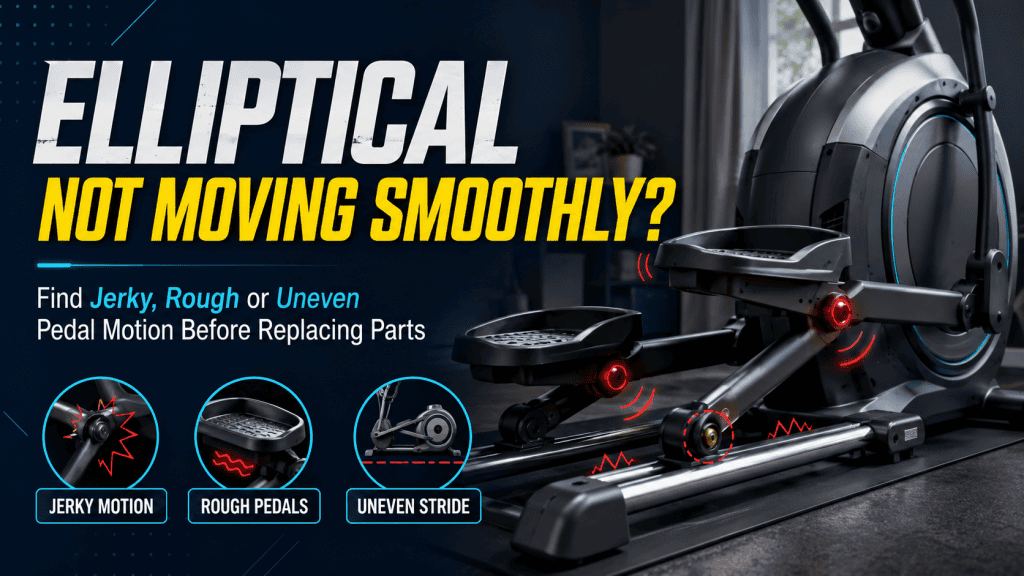
An elliptical is supposed to carry you through one continuous stride. When the pedals start catching, hesitating or lurching through part of the rotation, the change is hard to ignore. The machine may still run, the console may look normal and the resistance may still respond, yet every revolution feels as though something is interrupting the motion.
An elliptical not moving smoothly can have a cause as simple as debris on a track or a machine that is not sitting level. It can also come from a damaged roller, loose pedal hardware, a worn pivot, drive resistance or a problem deeper in the flywheel and belt system. Do not start by ordering bearings or spraying lubricant around the rails.
The useful clue is where the roughness appears. Does it happen at the same point on every revolution? Is one pedal worse than the other? Does it appear only when you put your full weight on the machine, only at higher resistance, or only after the elliptical has warmed up? Those differences tell you much more than the word ‘jerky’ on its own.
Safety first: Switch off and unplug the elliptical before inspecting accessible rails, rollers, pedals or hardware. Do not perform powered tests with protective covers removed. Stop using the machine for a hard bind, unstable pedal, cracked part, smoke, burning smell, severe grinding or damaged wiring.
In this guide 21 sections
Start by describing the rough motion properly
Before touching the machine, spend a minute watching and feeling the fault. A smooth elliptical can still feel heavier at high resistance, but the load should remain reasonably even through the stride. A mechanical problem tends to add a catch, bump, scrape, wobble or sudden change at a repeatable point.
Try to separate four things: resistance, rhythm, location and load. If the pedals are uniformly harder to move after you increase resistance, that may be normal. If one point in the stride suddenly becomes stiff and then releases, that is different. If the problem follows one pedal, look locally. If both pedals feel rough at the same point, the shared drive path becomes more interesting.
Do not force the machine through a hard bind. A pedal that suddenly locks, drops, shifts sideways or loses support is a stop-use symptom, not an invitation to pedal harder.
A quick symptom map
| What you feel | Where to look first |
| A bump at the same point every stride | Rail contamination, roller flat spot, contact, alignment or a rotating component |
| One pedal feels rougher than the other | Local roller, pedal arm, pivot, pedal mounting or side-specific hardware |
| Both pedals hesitate together | Shared drive, crank, flywheel, belt, central bearing or common rail system |
| Smooth unloaded, rough under body weight | Play, roller or pivot wear, frame stability, load-related drive resistance |
| Roughness changes sharply with resistance level | Resistance or drive loading rather than a simple rail problem |
| Machine rocks or twists while pedalling | Floor, levelling feet, frame hardware or structural stability |
| Roughness comes with squeaking, clicking or grinding | Use the noise pattern as an extra diagnostic clue |
| Only rough after several minutes | Heat-related bearing, belt or drive behaviour; service may be needed |
If your symptom does not fit one of these patterns, start with our elliptical troubleshooting guide for a broader symptom-by-symptom diagnosis, then return here if the problem is specifically rough, jerky or uneven pedal motion.
Five checks to do before you go deeper
- Confirm the machine is firm and level, with every levelling foot carrying weight.
- Clean accessible rails and roller paths using the method approved for your model.
- Compare both sides for a damaged roller, loose pedal arm, pivot play or misalignment.
- Note whether the fault changes with body weight, resistance, direction or warm-up time.
- Stop for a hard bind, unstable pedal, cracked part or severe grinding, and use model-specific service guidance.
Check the floor and levelling before you blame the drivetrain
A surprisingly large number of ‘rough motion’ complaints begin with the frame moving instead of the stride mechanism. If one levelling foot is not carrying weight, the elliptical can rock from corner to corner as your body moves. That rocking can feel like an uneven pedal stroke even when the rotating parts are healthy.
LifeSpan troubleshooting guidance for its ellipticals starts instability checks with a solid, level surface and correctly adjusted feet. That is worth doing before any mechanical work because it costs nothing and changes how loads travel through the frame.
Stand beside the machine and press down gently on different corners. If the frame clicks or shifts, correct the levelling using the procedure in the manual. Also make sure the machine has not been placed partly on a soft mat, floor joint or uneven tile. If it was recently moved, recheck the feet rather than assuming their old setting is still correct.
Clean rails and roller paths before reaching for lubricant
On tracked ellipticals, the rollers and rails are part of the stride. A small ridge of dust, dried residue or material shed from a wheel can be felt under load every time the roller passes over it. This can create a bump that seems much more serious than the contamination causing it.
LifeSpan manuals specifically note that debris on ramp rails can produce a rough feeling in the pedals. Horizon likewise tells owners to clean debris from pedal arm wheels and guide rails as part of routine maintenance. Precor’s commercial maintenance guidance includes checking that elliptical wheels run smoothly on the ramp and cleaning both ramps and wheels.
With the machine off and unplugged where applicable, wipe accessible rails and wheel surfaces with the method approved for your model. Look for a line of compacted dirt, sticky residue, a small stone or a piece of material embedded in the roller path. Rotate only as far as the machine moves freely and safely. Do not put fingers between a roller and rail.
There is an important trap here. Cleaning a rail and lubricating a rail are not the same thing. Horizon’s tracked elliptical guidance explicitly says not to add lubricant to the track or wheels. Other designs may specify a lubricant at particular pivots. Follow the exact manual rather than assuming a slippery track must be better.
Look closely at the rollers, not just the rails
A clean rail cannot make a damaged roller round again. Inspect each accessible wheel for chips, flat spots, cracking, deformation or a worn band around the running surface. A flat spot often gives a very regular bump because it returns once per wheel rotation.
Compare left and right sides. One roller sitting at an odd angle, showing noticeably different wear or moving sideways on its axle can explain why one pedal feels worse. If the wheel has obvious play, binds when moved by hand, or no longer follows the rail squarely, stop treating the problem as dirt.
Do not assume every visible line or dark deposit on a roller is damage. Horizon owner guidance notes that roller wheels can leave particles on the guide rails as part of normal wear. The meaningful evidence is a change in shape, looseness, rough rotation or a mark that corresponds with the point where the stride catches.
One rough pedal and two rough pedals are different clues
If the left pedal feels rough but the right side remains normal, focus first on components unique to the left side: its roller, pedal arm, pivot joints, pedal mounting and local hardware. A shared drive component can still transmit unevenly, but a one-sided symptom gives you a useful place to begin.
If both pedals hesitate together, look for something they share. Depending on the design, that may include the main axle, crank, flywheel, drive belt, resistance system, central bearings or a common rail assembly.
This distinction is especially useful when the machine feels normal without a user and rough only under body weight. Load can reveal play in a joint, roller bearing or pedal connection that is difficult to see while the machine is unloaded.
Check pedal arms, pivots and assembly hardware for play
Ellipticals move through a network of joints. A small amount of looseness in the wrong place can change the path of a pedal under load. The result may feel like a hitch, side-to-side movement or a knock as the joint changes direction.
Horizon recommends periodic inspection of assembly bolts and pedals, and its maintenance material notes that frame bolts can loosen as a new machine settles. LifeSpan troubleshooting likewise tells owners to check assembly hardware when there is excess play in the handlebars or frame components.
With the machine switched off, compare corresponding joints on both sides. Look for a fastener that has backed out, a pedal platform that rocks independently, or a pivot with obvious side play. Tighten only to the manufacturer’s specification and assembly method. More torque is not automatically better. Over-tightening a pivot that is designed to move can create its own stiffness or damage.
If you see a cracked arm, distorted bracket, damaged weld or a joint that will not stay secure, stop using the machine and arrange service.
Do not confuse a resistance problem with a rough stride
Resistance changes how much effort the flywheel system asks from you. It should not normally create a sharp catch at one precise point of every revolution. If the entire stride becomes uniformly heavier or lighter, particularly when you change the level on the console, the resistance system deserves more attention than the rollers.
Try a low resistance setting only if the machine is otherwise safe to use. If the motion becomes smooth as resistance drops and rough again as resistance rises, note that pattern. It does not prove the resistance motor or brake is faulty, but it tells you the symptom is load-dependent.
If the resistance will not change at all, changes by itself, or the display changes while the physical resistance does not, use our elliptical resistance troubleshooting guide. That is a different fault path from a pedal that physically catches on a rail or pivot.
What if the elliptical is smooth backwards but jerky forwards?
Directional differences are useful, but they need careful interpretation. Some elliptical mechanisms load pivots, rollers and belt paths differently in forward and reverse motion. A worn joint or marginal roller can therefore feel worse in one direction.
If your model is designed to be used in both directions, compare the two gently at low resistance. A fault that appears only in one direction points towards a component whose loading changes with direction, rather than a general lack of power. Do not use reverse motion as a diagnostic test if the manufacturer does not permit it.
If the catch happens at exactly the same point every stride
Repeatability is one of the best mechanical clues. Put a small removable visual reference on the outside of the pedal arm or watch an existing moulding mark. If the hesitation occurs at the same arm position each time, look for something that also returns to the same position: a roller flat spot, contact with a shroud, a bent component, crank alignment or an issue around the rotating drive assembly.
Listen at the same time. A physical catch accompanied by a click, scrape or grind belongs partly to the noise pathway. Our elliptical noise troubleshooting guide goes deeper into squeaking, grinding, clicking and thumping, and what the timing of each sound can reveal.
If there is no sound but a pronounced notch can be felt through both pedals, do not keep loading the machine in the hope that it will wear itself smooth. Internal bearings or drive components may need inspection by a technician.
If the motion gets rough only after 10 or 20 minutes
A time-dependent change deserves its own note. Heat can change clearances and expose wear in bearings, belts and drive components. A bearing or belt that is marginal when cold may become noticeably rough after sustained use.
Record how long the elliptical runs before the symptom appears, whether resistance level affects the timing, and whether the machine returns to normal after cooling. That information is much more useful to a technician than simply saying the pedals sometimes feel rough.
Stop if the roughness is accompanied by a hot smell, visible belt dust, smoke, electrical odour or a growing grinding noise. Those signs move the problem beyond routine owner maintenance.
When the machine was recently assembled, moved or serviced
A new rough stride can be an assembly clue. Rail sets, pedal arms and upright structures often have multiple fasteners that must align before being fully tightened. If hardware was tightened with a component pulled out of position, the mechanism can bind through part of its travel.
Do not loosen the whole machine at random. Go back to the assembly sequence for the exact model. Check that washers, spacers and left/right parts are installed in the specified order and that cables have not been trapped. Horizon’s 7.0 AE assembly guidance, for example, instructs users to get all nuts and bolts in place and partially threaded before fully tightening any one bolt. That helps prevent an assembly from being pulled out of alignment.
If the problem began immediately after professional service, contact the service provider before dismantling anything yourself. A repair history is valuable diagnostic evidence.
The drive belt, flywheel and bearings are where DIY diagnosis usually ends
Once rails, wheels, levelling and accessible hardware are ruled out, the remaining causes become more machine-specific. Many ellipticals use a belt to transfer pedal motion to a flywheel, with bearings supporting the crank, flywheel or pedal pivots. Wear, misalignment or damage in those parts can create roughness that is transmitted through both pedals.
This is where online advice often becomes too confident. A rough stride is not proof of a bad bearing, and a worn drive belt does not always announce itself with obvious slipping. The exact layout, belt tension procedure, bearing arrangement and access method vary significantly between models.
Precor’s maintenance schedule for ellipticals includes checking drive belts and pulleys and verifying that wheels run smoothly, but those tasks sit within a maintenance programme for trained service. If the diagnosis requires removing covers and operating the machine near exposed belts, flywheels or powered electronics, that belongs with a qualified technician unless the manufacturer explicitly provides an owner procedure.
Lubrication is not a universal cure for jerky elliptical pedals
A can of lubricant is tempting because friction feels like the obvious explanation. It is also one of the easiest ways to make the wrong fix.
Different elliptical designs use different materials and bearing arrangements. Horizon owner guidance notes that its elliptical bearings are sealed and do not need lubrication, while its tracked-elliptical maintenance guidance says to keep the track and wheels clean without adding lubricant. Other designs may specify grease at particular pivots. Putting oil or silicone on the wrong surface can attract dust, contaminate a roller, affect traction or make later service harder.
Use lubricant only where the manual for the exact model calls for it, and use the specified type. If the manual tells you to clean the rails dry, do that instead.
A sensible order to diagnose jerky or uneven elliptical motion
- Confirm the machine is on a firm, level surface and that all levelling feet are supporting it.
- Clean accessible rails, roller paths and pedal areas using the method approved by the manufacturer.
- Inspect rollers for debris, flat spots, cracking, unusual wear, side play or rough rotation.
- Compare the left and right pedal arms, pivots and accessible fasteners for looseness or misalignment.
- Note whether the problem changes with body weight, resistance level, direction or warm-up time.
- If the fault is accompanied by noise, use the timing of the sound to narrow the same mechanical path.
- If the easy checks are clean but the stride still binds, stop before opening powered drive compartments and arrange model-specific service.
When to stop using the elliptical
A little surface dirt on a rail is one thing. Unstable or unpredictable motion is another. Stop using the machine if any of the following is true:
- A pedal drops, shifts sideways or feels as though it could lose support under your foot.
- The frame still rocks or twists after the machine has been correctly levelled.
- A roller is visibly damaged, badly deformed or binds instead of turning smoothly.
- A joint has major play, or a pedal arm or mounting point moves independently when it should not.
- You can see a cracked arm, bent bracket, damaged weld or another structural defect.
- The stride binds hard or catches abruptly instead of moving through a continuous path.
- You hear heavy grinding that is getting worse or is accompanied by a strong mechanical catch.
- There is smoke, a burning or electrical smell, damaged wiring, or heat that seems abnormal.
Do not remove protective covers and then run the elliptical simply to watch what happens inside. Moving flywheels, belts and linkages can cause serious injury, and powered electronics add another hazard.
The owner’s manual and service information for the exact model take priority over a generic troubleshooting guide.
What a technician can check when the easy causes are gone
A technician can do more than replace the first worn-looking part. With the correct service documentation, they can isolate play in bearings and pivots, inspect drive-belt condition and alignment, check crank and flywheel movement, assess resistance-system loading, confirm rail and frame geometry and identify contact that appears only under load.
Give them the clues you collected: whether one or both pedals are affected, the point in the stride where it happens, cold versus warm behaviour, forward versus reverse behaviour if applicable, resistance level, recent assembly or service work, and any accompanying noise. Good observations shorten diagnosis.
Before you buy parts, answer these five questions
- Does the roughness happen at the same point every revolution?
- Is one pedal worse, or do both pedals change together?
- Does the fault appear only when someone is standing on the machine?
- Does changing resistance change the roughness, or only the effort?
- Did the problem begin after assembly, moving, maintenance or a new noise?
If you can answer those questions, you have already narrowed the diagnosis more effectively than a parts list can. Keep the answers with the machine model and serial number if you contact support or a technician.
The part that matters most is the pattern
When an elliptical is not moving smoothly, the instinct is to find the component with the most intimidating name. In practice, the pattern usually gets you further.
A bump that repeats at the same point suggests something rotating or travelling through that point. One rough pedal points towards a local arm, roller or joint. Both pedals changing together pushes attention towards a shared drive component. A problem that appears only under your weight adds load to the diagnosis. A problem that changes with resistance may belong to the resistance or drive system rather than the rail.
Start with the floor, rails, rollers and accessible hardware. Keep the machine-specific manual beside you. If those checks do not explain the fault, stop guessing and let the deeper drive components be inspected properly. That approach is slower than spraying lubricant everywhere, but it is much more likely to fix the real problem without creating a second one.
Frequently asked questions
Why are my elliptical pedals jerking even at low resistance?
Low resistance does not rule out a mechanical problem. Check whether the frame is level, the rails and rollers are clean, a wheel has a flat spot, or a pedal arm or pivot has play. If both pedals catch together at the same point, a shared drive component may need inspection.
Can dirty elliptical rails really make the pedals feel rough?
Yes. Manufacturer guidance from LifeSpan specifically notes that debris on ramp rails can create a rough pedal feel, and Horizon includes cleaning pedal arm wheels and guide rails in routine maintenance. Clean using the method specified for your model.
What causes elliptical pedal sticking, and should I lubricate the rails?
Not automatically. Horizon specifically says not to lubricate the tracks or wheels on tracked ellipticals. Other machines may have model-specific lubrication points. Follow the exact owner or service manual rather than using a universal lubricant.
Why do my elliptical pedals feel rough on one side?
A one-sided symptom usually makes the local roller, pedal arm, pivot, pedal mounting and hardware more relevant. Compare the affected side with the other side while the machine is off. Obvious looseness, a damaged wheel or a cracked component should be repaired before further use.
What causes an elliptical to catch at the same point every revolution?
A repeatable catch can come from a roller flat spot, debris at a fixed point on a track, contact between moving parts, misalignment or a problem in a rotating drive component. The fact that it repeats is useful because it links the symptom to something that returns to the same position.
Can high resistance make an elliptical feel jerky?
High resistance should make the stride harder, but normally it should remain reasonably continuous. If the physical motion becomes uneven only at higher resistance, note the pattern and check the dedicated resistance troubleshooting path. If resistance itself will not change, treat that as a separate fault.
Sources
- Horizon Fitness, How do I Perform Routine Maintenance for my Elliptical?
- Horizon Fitness, Elliptical and Ascent Trainer Care and Maintenance
- LifeSpan E2i/E3i Elliptical Cross Trainer owner manual, troubleshooting section
- LifeSpan E5i Commercial Elliptical Trainer owner manual, troubleshooting section
- Precor, Preventative Maintenance guidance for elliptical equipment
- Horizon Fitness, 7.0 AE Elliptical Assembly
- Horizon Fitness, elliptical owner’s guide: sealed bearings and normal roller-wheel particles