
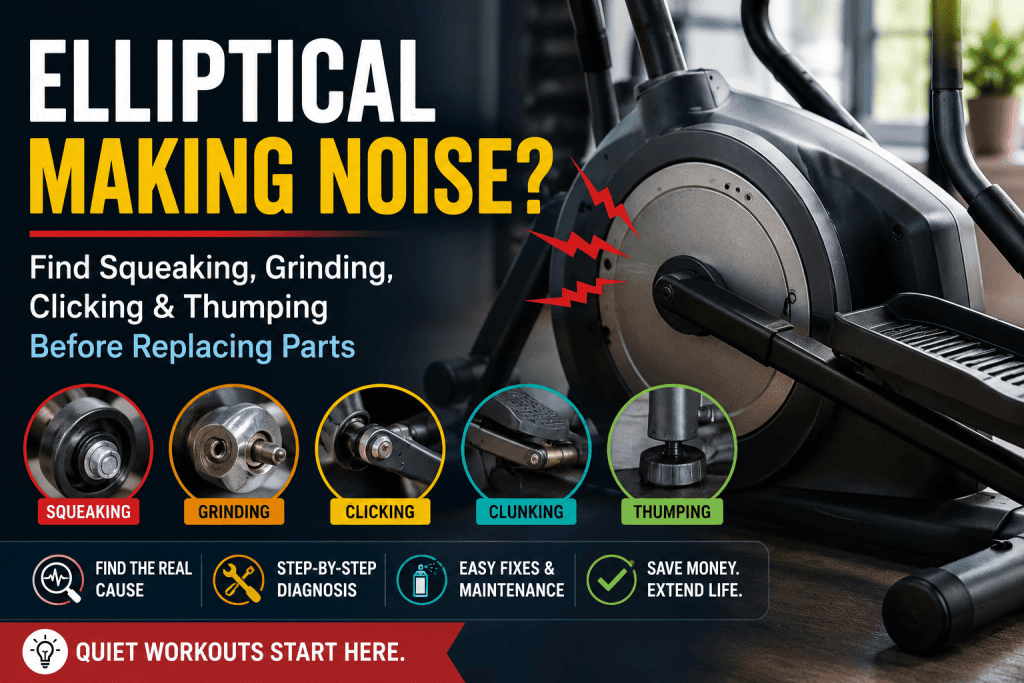
An elliptical that suddenly starts squeaking can make a small problem sound expensive. A grind from the front housing feels even worse. The temptation is to search the noise, pick the first part somebody mentions, and order a bearing, belt or flywheel.
That is usually too early. Noise is useful evidence, but only when you pay attention to its rhythm, location and timing. A squeak that appears only when the moving handlebars are used points in a different direction from a scrape that continues through every revolution. A thump from a rear rail can sound as though it is coming from the flywheel because the frame carries the vibration. A click that occurs once per stride is not the same clue as a fast series of clicks that rises with speed.
Manufacturer guidance reflects that difference. Horizon separates squeaks, grinding, thumps and clicking in its elliptical noise flow chart. SOLE warns that loose assembly hardware and dirty rear rails can create noises that seem to come from inside the machine. The practical lesson is simple: before you replace anything, work out what the elliptical is actually telling you.
This guide is for an elliptical making noise but still able to move through its stride. If the machine also has a dead display, changing resistance, failed incline or another primary fault, use the dedicated FixDecoded guide for that symptom rather than treating every problem as a noise problem.
In this guide 18 sections
Start by describing the noise properly
You do not need to know the name of every internal part. You need a repeatable description. Before touching a bolt, note whether the sound is a high squeak, a click, a dull knock, a thump, a rattle, a scrape or a rough grinding noise. Then notice when it happens.
| What you hear or feel | Useful clue | Start by checking |
| High squeak or chirp | Often changes with a joint, rail or flexing connection | Level, loose hardware, visible pivots, rollers and rails, using only the lubricant specified for the model |
| Click or tick | Often repeats at the same point in a stride or rotation | Pedal and arm hardware, shrouds, roller fasteners, crank-area play |
| Thump or knock | May follow a wheel, rail, loose joint or shifting frame connection | Clean rails and wheels, then check external hardware and levelling |
| Rattle or creak | Often comes from a panel, mast or frame joint rather than the drive system | Shroud screws, console mast, stabilisers and assembly bolts |
| Scrape or rub | Suggests unwanted contact with a moving part | Visible clearances, debris, shifted covers or rollers; stop if contact is severe |
| Grinding or rumbling | More concerning for worn bearings, damaged rollers or internal drive contact | Stop strenuous use and arrange deeper inspection if the sound is persistent or felt through the pedals |
The most useful test is not louder or quieter. It is what changes the sound.
If the elliptical can be used safely for a brief observation, change only one thing at a time. That gives you evidence instead of noise chasing.
- It happens with nobody on the pedals. The cause is less dependent on body weight. Think about rollers, covers, drive rotation, a fixed rub or a component that moves whenever the machine moves.
- It appears only under body weight. Frame flex, loaded joints, pedal-arm connections, wheel contact and bearings move higher on the list.
- It gets much worse when you use the moving handlebars. Upper and lower handlebar pivots, the console mast and their connections deserve attention before the flywheel.
- It happens at one point in every stride. Look for a repeating contact point, roller defect, crank or joint issue rather than a random loose object.
- It gets faster when you pedal faster. The source is probably tied to something rotating or cycling with the stride.
- It appears only at high resistance. The noise may involve the resistance or drive system. Do not adjust internal brake or belt geometry without the service procedure for the model.
- It starts after ten or twenty minutes. Heat, load and changing clearances may be involved. A temporary squirt of lubricant that quietens it for a few minutes is not proof that the sprayed joint is the real cause.
Noise can travel surprisingly well through a steel frame. SOLE specifically notes that dirt on rear rails can create a thumping sound that seems to come from inside the main body. If you are unsure of the source, have another adult use the machine briefly while you listen from a safe distance. Keep hands, clothing and tools away from moving parts. Do not remove protective covers and then run the machine simply to make the diagnosis easier.
Before you lubricate anything, check the manual
Blanket advice to spray lubricant on every moving joint is one of the easiest ways to turn a minor squeak into a messy diagnosis. Ellipticals do not all use the same rail materials, bushings, bearings or lubricants.
The variation is easy to see in manufacturer documentation. One Horizon guide specifies lithium-based grease on the top surface of certain guide rails. A ProForm manual tells owners of that model to clean squeaking rollers and tracks with rubbing alcohol and then apply a small amount of PTFE grease. Some roller and bearing assemblies have no owner-level lubrication procedure at all, which is another reason to check the manual before applying a spray.
Use the lubricant and location stated in the manual for your exact model. Do not assume that silicone spray, white lithium grease, PTFE grease, penetrating oil and general-purpose oil are interchangeable. They are not. Avoid getting lubricant onto belts, braking surfaces, electrical parts or any track where the manufacturer says it should remain dry.
1. Check the floor, levelling feet and assembly hardware first
A new noise after moving the elliptical, assembling it, or changing rooms is a strong reason to begin outside the machine. A frame that is not sitting evenly can twist slightly under each stride. A console mast or stabiliser bolt that has settled loose can creak under load. The sound may be transmitted through the frame and appear to come from somewhere else.
Horizon lists loose frame bolts as a common source of elliptical noise and recommends periodic checks. SOLE also puts assembly hardware near the top of its noise diagnosis. That does not mean every bolt should be forced tighter. Pivot joints can use shoulders, sleeves, washers or specified torque values. Tighten ordinary assembly hardware to the manufacturer’s procedure and stop if a joint binds after adjustment.
Also check whether all levelling feet are firmly in contact with the floor. Rock the machine gently while it is switched off. If one corner lifts, correct the level according to the manual. A fitness mat can reduce sound transmitted into a timber floor, but it should not be used to hide mechanical looseness.
2. Clean the rollers and rails before blaming an internal bearing
Tracked ellipticals generate a lot of misleading noise at the back of the machine. Dust, hair, dried sweat and polyurethane residue can build on the roller surface or rail. A small lump can produce a regular thump once per wheel rotation. A dirty rail can squeak. A damaged or flat-spotted roller can add a bump that you feel through one pedal.
Horizon treats some wheel-on-track sound as normal and recommends keeping the track and wheels clean and free of debris. SOLE goes further in its maintenance guidance, telling owners to clean rear rails and polyurethane wheels when noise develops because buildup can be amplified through the frame.
With the machine unplugged where applicable, wipe the exposed rails and roller surfaces using the cleaning method specified by the manufacturer. Inspect for a pebble, hardened debris, cracks, flat spots, missing material or a wheel that is no longer sitting squarely on the rail. If your manual calls for track lubricant, use the exact type and quantity it specifies. More lubricant is not better. Excess can collect dust and may change how the wheel rolls.
3. If the elliptical is squeaking or chirping
An elliptical squeaking on every stride often sends people straight to the flywheel. In practice, a squeak can come from much closer to your feet or hands. Dry pivots, threaded assembly joints, pedal-arm bushings, rollers, rails and the frame itself can all create a high, repetitive sound.
If the squeak changes when you stop using the moving handlebars
That is a valuable clue. The swing-arm pivots, lower handlebar joints and mast connections are moving differently when you take your hands off the arms. Inspect the accessible fasteners and joint locations shown in the manual. Do not spray lubricant into a joint that you cannot identify. If the joint uses a bushing or sleeve that requires grease, proper servicing may mean disassembly, cleaning and re-greasing rather than spraying the outside.
If the squeak is strongest at the rear track
Clean first. If the sound disappears temporarily after cleaning, inspect the roller surfaces closely before adding lubricant. If the manual specifically instructs you to grease the rail or track, follow that procedure. ProForm, for example, has models where squeaking rollers are treated by cleaning the track and roller, then applying a measured amount of PTFE grease. That is a model-specific instruction, not a universal rule for every elliptical.
If the squeak arrives only after the machine warms up
Do not assume that heat means an electrical fault. Bushings, bearings and frame joints can change slightly as the machine warms and loads repeat. The more useful observation is where the sound is strongest when it begins and whether it follows one side, one joint or one point in the stride. A squeak that becomes a grind, or arrives with roughness or looseness, deserves a more cautious response than a light dry-joint chirp.
4. If the elliptical is clicking or ticking
A click gives you something a squeak often does not: a count. Listen for how often it occurs in one complete stride. One click at the same pedal position suggests a repeating contact or loaded joint. Several clicks per revolution can point towards a different rotating component.
Start with embarrassingly simple possibilities. Secure loose shoelaces and anything hanging from clothing. Check pedal fasteners, visible arm hardware and shroud screws. A plastic cover that shifts by a fraction under frame flex can make a sharp click that sounds mechanical. A roller bolt with side play can click each time the wheel is loaded.
Johnson Health Tech’s service flow chart treats clicking as a separate branch from squeaking and grinding and even uses the number of clicks per rotation as a diagnostic clue. That is useful reasoning, but the part conclusion in a service chart is specific to the machine family it was written for. Use the rhythm to locate the system, then use your model’s manual before changing parts or torque settings.
5. If you hear a thump, knock or clunk
A dull thump often comes from a part that loads and unloads rather than rubs continuously. On a tracked elliptical, debris or a damaged roller can produce a regular thump. Loose assembly hardware can knock when body weight transfers from one side to the other. A pedal or arm joint with play can create a clunk at the same point in every stride.
Try to separate sound from feel. If you hear a thump but the pedals remain smooth, inspect rails, wheels, covers and frame joints first. If you can also feel a knock through one pedal or handle, stop treating the problem as cosmetic. Play in a loaded joint or bearing can worsen and change the stride geometry.
This is also where the room can fool you. Horizon notes that fitness equipment may sound louder at home than in a large showroom because timber floors, nearby walls and room acoustics reflect and transmit more sound. A mat can reduce reverberation, but a new clunk that follows the stride still needs a mechanical check.
6. If the elliptical is grinding, scraping or rubbing
Grinding deserves more attention than an occasional light squeak. It suggests rough rolling, damaged bearing surfaces, a failing roller, or internal contact that should not be happening. A clean scraping noise can also mean a cover, belt guard or other part has shifted into the path of something moving.
Switch the machine off and unplug it if it uses external power. Look only at areas you can inspect safely without defeating guards. Check whether a wheel is rubbing the edge of a rail, whether debris is trapped in a visible track, or whether an outer shroud has moved. Do not reach into the flywheel or belt area.
If the sound comes from inside the front housing, is accompanied by vibration or roughness through both pedals, or leaves metal or black debris where there should be none, stop using the machine until it is inspected. Service documentation for ellipticals includes crank bearings, pedal axles, flywheel contact and drive components among possible sources of persistent grinding. That is not a parts-shopping list. It is a reason not to keep exercising on a machine that is physically grinding itself.
7. Rattles and creaks often come from the frame, mast or covers
A rattle is different from a repeating drive noise. It may be a loose plastic shroud, bottle holder, console mount, transport wheel, stabiliser or fastener. A creak often appears as the frame flexes under alternating body weight.
With the machine off, press gently on the console mast, fixed handlebars and accessible covers. You are not trying to bend anything. You are checking whether the same sound can be reproduced without rotating the drivetrain. If it can, you have narrowed the problem considerably.
Recheck the hardware that was fitted during assembly, especially if the noise appeared after relocation. Tighten only to the manual’s instruction. If a bolt repeatedly works loose, look for the manufacturer’s approved thread-locking guidance rather than substituting permanent adhesive.
A quick way to localise the sound without dismantling the machine
- Find the model number and open the owner’s manual. Check the maintenance section before using any cleaner or lubricant.
- With the elliptical switched off, make sure it is level and stable. Check exposed assembly hardware, pedals, mast and covers for obvious looseness.
- Clean visible rails and rollers. Remove debris before adding anything to the surface.
- If safe to test, pedal slowly and identify whether the noise follows one side, one point in the stride, every wheel rotation, the moving handlebars, high resistance or body weight.
- Repeat one observation with the moving handlebars unused. If the noise changes sharply, focus on the arm and mast joints.
- If the sound is a click, count it. If it is a thump, note whether you can feel it. If it is a grind, stop prolonged testing.
- Only after the source is reasonably localised should you use the model-specific lubrication, adjustment or part procedure.
- If the noise is internal, severe or accompanied by rough movement, heat, odour or instability, move to service rather than deeper trial-and-error repair.
Do not make these common noise fixes
- Do not spray lubricant everywhere. It can contaminate belts and braking surfaces, attract grit, wash grease out of a joint or simply mask the sound long enough to confuse the diagnosis.
- Do not overtighten every pivot bolt. Some joints depend on sleeves, bearings and specified torque. If movement binds after tightening, stop and use the proper procedure.
- Do not run the elliptical with covers removed just to listen. Exposed moving and electrical parts create unnecessary risk.
- Do not replace the flywheel because the sound seems to come from the front. Frames transmit sound. Prove the simple external causes first.
- Do not ignore a new grind because the machine still works. Mechanical contact and failing bearings can turn a serviceable problem into a more expensive one.
- Do not copy a lubricant recommendation from a different brand or model. The correct product and location vary between machines.
Some elliptical noise is normal
Not every sound is a fault. Tracked ellipticals can produce a regular rolling sound as wheels travel over rails. Magnetic resistance systems can have a soft mechanical or electrical hum. Fans and self-generating systems add their own background sound. A machine can also seem louder in a small room than it did in a shop.
The warning sign is change. A new sound, a sound that becomes progressively louder, a sound tied to a new vibration, or a noise that appears with resistance loss, looseness or rough motion deserves investigation. Compare the machine with its own normal behaviour rather than expecting complete silence.
When to stop using the elliptical
- Grinding or scraping becomes severe, or you can feel roughness through the pedals or handlebars.
- A pedal arm, handlebar, roller or frame joint has visible play or shifts under load.
- The stride suddenly catches, locks, jumps or feels unstable.
- You find cracked hardware, a damaged weld, a broken roller, metal debris or a part rubbing through a cover.
- There is a burning smell, smoke, electrical arcing, repeated breaker trips or damaged wiring.
- The noise arrives together with loss of resistance, unintended resistance changes or another control fault that changes how the machine behaves.
- Diagnosis would require powered operation with guards removed or live electrical testing.
A quiet machine is not worth a risky test. If the source sits behind a drive cover and the manual does not provide an owner-level procedure, a fitness-equipment technician can isolate the linkage, rollers, crank, belt, flywheel and bearings without guessing from the sound alone.
What a technician can check when the easy causes are ruled out
Once external hardware, levelling, rails, rollers and obvious contact are ruled out, diagnosis becomes more mechanical. A technician can separate linkages and rotate assemblies independently to work out whether the sound follows a pedal arm, crank, wheel, idler, belt or flywheel. They can check bearing play, belt tracking, internal clearances and resistance components using the service information for the exact model.
That matters because several internal faults sound similar through a closed shroud. Replacing a crank bearing will not fix a flywheel rub. Tightening a belt will not fix a damaged roller. The useful end point of DIY diagnosis is not always a repair. Sometimes it is being able to tell the technician, ‘the grind happens once per rotation under load and remains when I stop using the handlebars’. That is far more useful than ‘my elliptical is noisy’.
Common questions about an elliptical making noise
Why is my elliptical squeaking when I pedal?
Start with the simple external causes: level, assembly hardware, visible pivots, rollers and rails. If the squeak changes when you stop using the moving handlebars, the arm and mast joints become more likely. Lubricate only where the manual for your model tells you to.
Why does my elliptical make a grinding noise?
Persistent grinding is more concerning than a light squeak. Check for visible roller or rail damage and external rubbing with the machine switched off. If the grind comes from inside the housing or is felt through the pedals, stop prolonged use and have the drive, bearings and rotating assemblies inspected.
What causes an elliptical clicking noise once per stride?
A once-per-stride click often points to a repeating contact or loaded joint. Check pedal and arm hardware, roller fasteners, covers and obvious play. Count the click and note the pedal position where it occurs before opening anything.
Why does my elliptical thump only when I stand on it?
A load-only thump makes frame flex, loose joints, pedal-arm connections, rollers and rail contact more important. Clean the track first on a tracked machine, then check levelling and accessible hardware.
Can I use WD-40 on a squeaky elliptical?
Do not use a generic penetrating spray as a universal elliptical lubricant. Manufacturers specify different products for different joints and tracks, and some bearings or surfaces should not be lubricated externally at all. Use the exact maintenance instruction for your model.
Why is my new elliptical creaking?
New equipment can settle after its first few uses, and assembly hardware may need to be rechecked. Make sure the machine is level, then inspect the bolts and connections identified in the assembly manual. A persistent creak with movement or visible play should not be dismissed as normal.
Is a rolling sound from the rear rails normal?
Some tracked ellipticals naturally produce audible wheel-on-track noise. Keep the wheels and rails clean and compare the sound with the machine’s previous behaviour. A new thump, flat spot, scrape or vibration is different from a steady rolling sound.
The sound is a clue, not a diagnosis
When an elliptical is making noise, the fastest route to the right fix is usually to resist the urge to name a failed part. Start with the sound. Then add timing, location, body weight, speed, handlebar movement and resistance. Those details turn a vague complaint into a mechanical pattern.
Level the machine. Recheck the hardware that was actually assembled. Clean the rails and rollers. Use only the lubricant your manual specifies. A squeak, click or thump that disappears after one of those checks has saved you an unnecessary part. A grind that remains after them has earned a proper internal inspection instead of another guess.
That is the difference between silencing a noise for a week and fixing the reason it started.
Sources
• Horizon Fitness, Frequently Asked Questions: Elliptical and Ascent Trainer Noises
• Horizon Fitness, Elliptical and Ascent Trainer Care and Maintenance
• Johnson Health Tech, Elliptical Troubleshooting Guide: Noise Flow Chart
• SOLE Fitness E55 Elliptical Owner’s Manual, maintenance and noise guidance
• Johnson Health Tech owner guide, rail lubrication and squeak troubleshooting
• ProForm owner documentation, maintenance and roller-greasing guidance
• Schwinn Fitness, 490 / 590Ei elliptical service and troubleshooting resources