
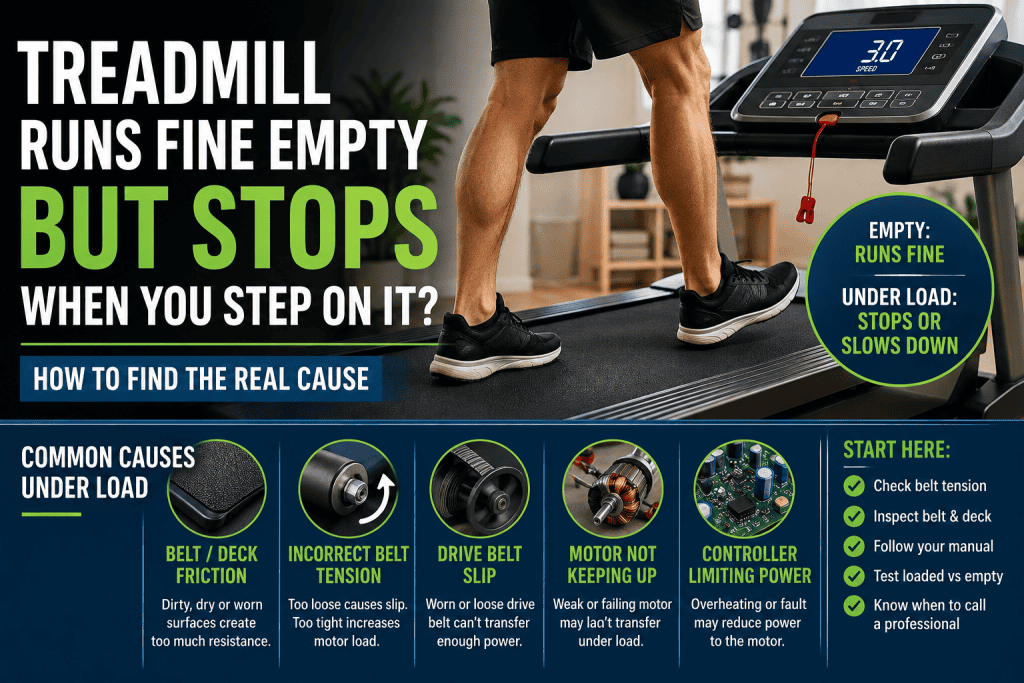
If your treadmill belt stops when you step on it but runs normally with nobody on it, the machine has already given you a useful diagnostic clue. It can move the belt without much load. The problem appears when your weight presses the walking belt against the deck and the drive system has to produce more torque.
That does not automatically mean the motor is weak. It also does not automatically mean the walking belt needs tightening. A loose walking belt, excessive deck friction, a slipping drive belt, worn running surfaces, roller resistance, a motor problem or controller protection can all create a similar complaint.
The safest way forward is to separate a belt that is slipping from a drive system that is actually stalling under load.
Start here: Check the treadmill model, rated user weight and the manufacturer’s belt-maintenance instructions. Then work out whether the problem is a brief slip under each footfall or a general loss of speed whenever body weight is added.
Safety: Do not attempt to remove the motor cover and then walk on the treadmill to watch belts or pulleys until or unless you are trained, certain what you’re doing and follow the manufacturer service procedure. Keep hands, clothing and tools away from moving parts, and unplug the machine before inspections.
| What you feel or see | Where to look first |
| Brief slip under a firm step | Walking-belt tension, belt condition and traction |
| Whole belt slows whenever weight is added | Belt/deck friction, excessive tension or drive capacity |
| Runs normally after you step onto the side rails | A load-related fault is strongly indicated |
| Stops after several minutes rather than immediately | Add heat and sustained overload to the diagnosis |
| Console also resets or flickers | Check the electrical supply and power path as well as the drive system |
In this guide 18 sections
Why a treadmill belt stops when you step on it
With nobody on the machine, the motor only has to overcome the basic resistance of the belt, rollers, bearings and drive components. A person changes the load immediately. Body weight presses the walking belt onto the deck, and every step creates additional friction.
Precor service documentation treats current drawn under load as a direct indication of treadmill loading. Matrix service guidance uses a similar comparison: if unloaded current is acceptable but loaded current becomes excessive, the belt and deck become a primary area to inspect for high friction.
This is why a treadmill can look completely healthy when it is running empty and then slow badly as soon as somebody starts walking.
First decide whether the belt is slipping or the drive is stalling
These two faults feel similar but they are not the same.
A slipping walking belt often feels like this:
- the belt hesitates for a fraction of a second during a firm footfall
- the machine otherwise sounds close to normal
- the slip is most obvious when pushing off or landing heavily
- the problem may have developed gradually as the walking belt stretched
A drive system that is stalling under load often feels more like this:
- the entire walking belt loses speed while you remain on it
- the belt may recover quickly when you step onto the side rails
- the motor sound may labour or change
- the machine may eventually stop or display a drive or speed error
You do not need to expose the motor compartment to learn this first distinction. How the belt behaves under your feet is already useful evidence.
1. Confirm the treadmill is within its rated user weight
Check the maximum user weight in the manual or on the product specification label. A treadmill used beyond its rated capacity can struggle to maintain speed and can place extra stress on the belt, deck, motor and controller.
If the user is comfortably within the published limit, continue with the mechanical checks rather than assuming body weight itself is the fault.
2. Check walking-belt tension carefully
A loose walking belt is a common reason for a brief slipping sensation under footfall. Horizon’s T101/T202 service manual, for example, treats slipping as a normal belt-tension adjustment and specifies small quarter-turn changes, with a check after each adjustment.
The important lesson is not the exact adjustment for that Horizon model. It is the method: use the procedure for your treadmill, make small equal changes, and test rather than tightening aggressively.
Do not overtighten: If the walking belt is already tight enough, adding more tension can increase resistance and shorten belt or component life. If the problem gets worse after an adjustment, stop and return to the model-specific procedure.
3. Ask whether the fault began after a belt adjustment or service
This question can save a lot of time. If the treadmill worked properly until somebody adjusted the running belt, replaced the belt, moved the machine or worked on the rollers, revisit that work before blaming electronics.
Too little tension can allow slip. Too much tension can increase drive load. A belt that is off-centre can rub against a rail or edge. A replacement belt can also have a different maintenance requirement from the original.
4. Inspect the belt and deck for wear and friction
Switch the treadmill off, unplug it and let it cool. Inspect the walking belt and accessible deck surface.
Look for:
- a shiny or glazed belt underside
- fraying or exposed fibres
- heavy belt dust
- sticky or rough areas
- grooves or worn coating on the deck
- belt edges rubbing against the frame or side rails
- unusual heat after a short normal session
Wear matters because the extra friction may only become obvious when a person is on the belt. Matrix service documentation specifically states that when unloaded current is normal but loaded current is excessive, the running deck and belt should be checked for high friction.
5. Lubricate only if the treadmill is designed for it
Lack of lubrication can create high friction on treadmills that use a silicone-lubricated running surface. Horizon states that inadequate lubrication can contribute to premature failure of the belt, deck, motor or electronics.
However, Horizon also documents waxed running surfaces that should not have anything added to them. That is why “add silicone” is not a universal fix.
Check the owner’s manual before applying any product. If lubrication is required, use the approved type, amount and interval for that machine.
6. Watch what happens when you step off the belt
This is a simple and useful observation.
If the treadmill slows badly while you walk but returns to the selected speed as soon as you step onto the side rails, the problem is closely tied to load. That makes running-surface resistance, belt tension and the drive system more relevant than a fault that would occur identically with nobody on the machine.
If it behaves the same with or without a user, widen the diagnosis. Speed feedback, wiring, motor control or a non-load-related mechanical fault may be involved.
7. Consider the drive belt, rollers and motor if the running belt is not simply slipping
The walking belt is only one part of the drive path. Power must pass from the drive motor through the drive belt and front-roller system before the walking belt moves.
Matrix service guidance notes that excessive unloaded current can be associated with the motor, drive belt, belt tensioner or front and rear rollers. A fault in that path can be present even before a person steps onto the treadmill, then become much more obvious once additional torque is required.
Owner-level signs that justify professional inspection include unusual grinding, a new rubber smell, repeated squeal from inside the motor area, visible belt debris, or a treadmill that struggles even after walking-belt tension and deck condition have been checked correctly.
8. If it only fails after several minutes, add heat to the diagnosis
A treadmill that stops under your weight immediately is not quite the same problem as one that works for 10, 20 or 30 minutes and then stops.
If yours runs normally at first and fails later, read the FixDecoded guide on a treadmill that stops after 20 minutes. Heat, sustained current draw and controller protection become more relevant once time is part of the symptom.
9. Check the power arrangement if the display resets as well
If the walking belt slows but the display remains completely stable, start with the drive and running surfaces. If the console flickers, resets or the whole treadmill switches off when you step on it, the incoming power arrangement also deserves attention.
Use the electrical requirements in the owner’s manual. Avoid assuming that a circuit recommendation for a North American treadmill applies unchanged in another country. The correct voltage, circuit protection and connection method depend on the model and market.
Why replacing the motor first can waste money
A treadmill that slows under a user can sound as though the motor is weak. Sometimes it is. But a healthy motor can also sound strained when the belt and deck are creating far more resistance than they should.
If that resistance is not corrected, replacing the motor or controller may leave the underlying overload in place. Precor service guidance warns that prolonged high-current operation caused by running-belt/deck problems can damage the lower control system.
That is why the running surfaces should be checked before expensive electrical parts are condemned.
The professional test that separates load from guesswork
A technician can compare the treadmill’s electrical load with nobody on the belt and with a user walking under controlled conditions. The exact current limits are model-specific, so there is no responsible universal number to use at home.
If unloaded load is normal but loaded demand is excessive: high friction between the walking belt and deck becomes a strong suspect.
If unloaded demand is already excessive: the technician may inspect the drive motor, drive belt, rollers, bearings and belt tension for resistance.
If the mechanical load is reasonable but the belt still loses drive: the motor controller, drive motor and feedback system can then be tested with better evidence.
Technician boundary: Do not attempt current-draw or controller measurements unless you are trained to work on powered treadmill electronics. These tests can involve mains voltage, exposed moving parts and stored electrical energy.
A practical decision path
The belt slips briefly under each step: check the manufacturer procedure for walking-belt tension and inspect the belt condition.
The whole belt slows whenever weight is added: check belt/deck friction, excessive tension and drive-system load.
The belt recovers as soon as you step onto the side rails: treat it as a strong load-related clue.
The machine works under load at first but stops later: add heat, motor/controller protection and sustained friction to the diagnosis.
The console resets too: check the power supply and connection requirements in addition to the drive system.
Correct maintenance does not change the symptom: move to model-specific service diagnosis rather than continuing to tighten or lubricate.
What not to do
- Do not keep tightening the walking belt until it can barely lift from the deck.
- Do not add lubricant unless the manufacturer specifies that the running surface requires it.
- Do not keep walking on a belt that stops suddenly under your feet.
- Do not bypass breakers, safety keys or controller protection.
- Do not replace the motor or control board before the mechanical load has been checked.
- Do not carry out powered tests with covers removed unless you are trained and using the service procedure for that model.
When to stop troubleshooting
Arrange qualified service if you find:
- burning smell or smoke
- severe belt or deck damage
- repeated breaker trips
- grinding or damaged rollers
- a motor compartment that becomes excessively hot
- a belt that stops abruptly and creates a fall risk
- a fault that requires live electrical measurements to isolate
The bottom line
When a treadmill belt stops when you step on it, your weight is not just part of the complaint. It is a diagnostic load test. The added friction exposes a problem that the treadmill can hide while running empty.
Start by deciding whether the walking belt is slipping or the whole drive system is slowing. Check tension according to the actual manual, inspect the running belt and deck, and confirm the correct maintenance method. If the problem remains, loaded-versus-unloaded testing can help a technician separate excess mechanical resistance from a motor, controller or feedback fault. The goal is to find where the load is being lost before tightening, lubricating or replacing anything expensive.
Sources
- Horizon Fitness – T101/T202 Service Manual, Running Belt Tensioning and Centering
- Horizon Fitness – Running Deck/Belt Lubrication for Silicone Surfaces Only
- Horizon Fitness – Treadmill Care and Maintenance
- Precor – Running Belt and Deck Troubleshooting
- Matrix Fitness – How To Take an Amp Draw on Matrix Treadmills