
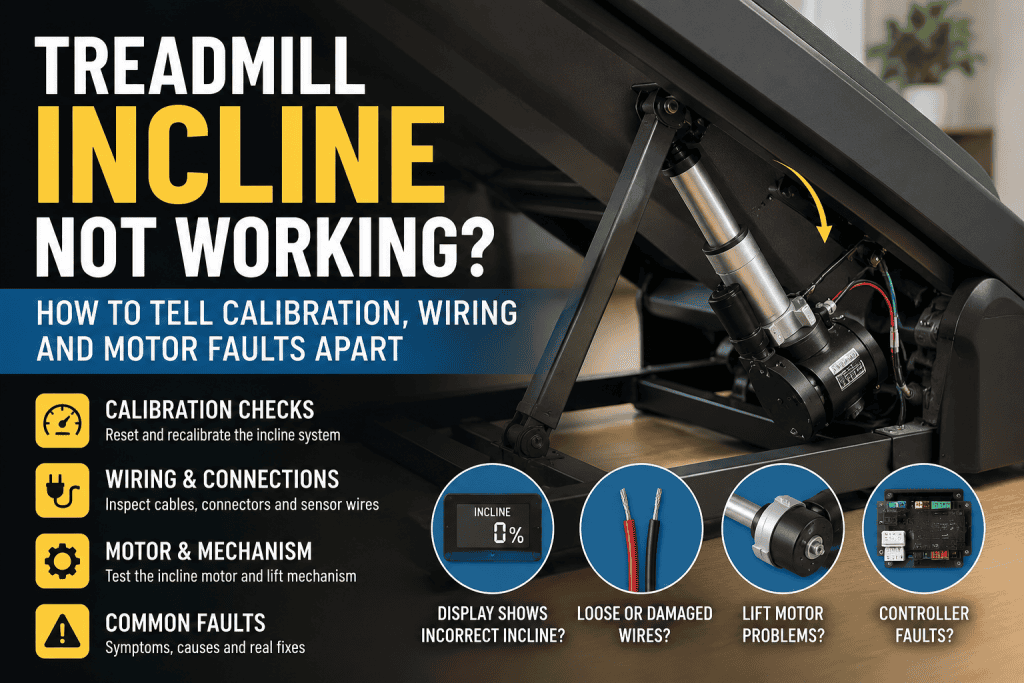
When you realize that a treadmill incline is not working, then the first advice you may find is to recalibrate it. That is sensible when the machine has simply lost track of its incline position and may work. But it is not a cure for a loose cable, a failed lift motor, a jammed actuator, damaged feedback wiring or a control board that is no longer driving the incline circuit.
That distinction matters because incline faults are easy to misread. The console can show 10 percent while the deck stays flat. The deck can rise but refuse to come back down. Calibration can start and then fail. A motor can hum without moving anything. On some machines, the problem appears immediately after the treadmill has been moved or assembled.
If your treadmill incline is not working, start by watching what the machine still does correctly. A few simple observations can tell you whether the problem is likely to be in the controls, the wiring, the position feedback, the lift mechanism or the electronics that drive it.
If more than the incline is misbehaving, start with the broader Treadmill Troubleshooting: Diagnose Common Problems by Symptom guide. It helps you decide whether you are dealing with a power, belt, incline, speed, noise or control problem before you go deeper.
In this guide 16 sections
The quickest way to narrow an incline fault
Before resetting anything, press an incline button once and watch both the display and the deck. Then note which pattern matches your treadmill.
| What you observe | Where to look first |
| Display changes, deck does not move | The console is registering the command. Look downstream at calibration, wiring, lift motor, position feedback and control output. |
| Display does not respond to incline buttons | Start with the console controls, software state and upper-console communication before blaming the lift motor. |
| Motor hums or buzzes, but the deck does not move | The command may be reaching the incline system, but the actuator or gearbox may be jammed or unable to move the deck. |
| Deck moves only up or only down | Direction control, wiring, feedback or limit logic deserves attention. Do not assume the whole motor is dead. |
| Deck moves, but the displayed incline is wrong | Calibration or position feedback becomes more likely. |
| Calibration starts and then fails | The treadmill is trying to move and verify position but cannot complete the expected travel or feedback sequence. |
| Problem began after moving or assembling the treadmill | Check disturbed, pinched or partially seated cables early. |
| Both belt and incline are dead while the console is on | A shared communication or lower-control problem may be involved, not two unrelated motor failures. |
Safety: Do not put hands beneath a raised deck, force an elevated treadmill down, or run the machine with exposed moving and electrical parts. Unplug it before checking accessible wiring. If the incline motor becomes very hot, smells burnt, repeatedly trips protection or the deck moves unpredictably, stop testing and arrange qualified service.
First, understand what calibration can and cannot fix
Incline calibration teaches the treadmill where its minimum and maximum positions are. On many machines the deck moves through a known range while the controller watches position feedback and stores or confirms the expected limits.
That makes calibration useful when the treadmill still has a functioning incline system but its position is wrong, its displayed grade no longer matches the deck, or the manufacturer specifically calls for recalibration after a reset or service event.
It does not repair a disconnected motor lead, a broken feedback wire, a seized actuator or a failed controller output. If calibration does not begin, or starts and repeatedly fails, the failure itself is useful evidence. The treadmill is telling you that it cannot complete the movement or feedback sequence it expects.
NordicTrack manuals illustrate why the exact model matters. Some older models enter incline calibration through a Stop and Speed-button sequence, while some touchscreen Commercial 1750 generations use a maintenance-menu calibration routine. Copying a calibration sequence from another model can simply send you in the wrong direction. NordicTrack Commercial 1750 manual reference
If the incline number changes but the deck stays still
This is one of the most useful clues. If you press 5 percent incline and the display changes from 0 to 5, the upper console has at least recognised the button press. That does not prove the command reached the lower controller or the lift motor, but it moves a dead incline button lower on the list.
Horizon tells owners to make exactly this observation before moving on to cable and wiring checks. Its incline troubleshooting guidance then has the treadmill powered off and unplugged before checking console-cable connections and accessible wiring for loose, damaged, disconnected, crimped or burnt conductors. Horizon Fitness: Treadmill Incline Issues
A common mistake is to interpret a changing number on the screen as proof that the incline motor has failed. In reality, the problem can still sit anywhere between the console command and the physical lift mechanism.
If the treadmill was moved, assembled or folded before the problem started
Give wiring a much higher priority when the incline worked before transport or assembly and failed immediately afterwards.
Treadmill uprights and motor compartments contain harnesses that can be pulled, pinched or only partly seated during assembly. Sunny Health and Fitness documents a very specific incline fault where the incline-motor sensor wire can become loose or disconnected, sometimes because the harness does not have enough slack as the motor moves. Their owner-level fix begins with the machine powered off and unplugged before the connection is inspected. Sunny Health & Fitness: Incline Not Responding
Repair forums tell the same story in less tidy language. Owners often start by pricing an incline motor, only to discover a disturbed connector or wiring issue after a move. That is why the history of the fault matters. A failure that began immediately after transport should not be diagnosed in the same order as a motor that gradually became noisy over several years.
If calibration starts but fails
A failed calibration is not the same thing as an incline system that never responds at all.
During calibration, the controller expects the deck to move and the position feedback to change in a believable way. If movement begins but the routine cannot finish, possibilities include a position sensor or feedback problem, wiring, a mechanical limit, an actuator that cannot complete its travel, or a control problem that appears only in one direction.
This is where forums can be useful for pattern recognition, but not as a substitute for model-specific service information. In one NordicTrack 2950 discussion, the owner swapped incline motors and then swapped a motor-control board, yet calibration still failed. That thread is a useful reminder that expensive part swapping can leave the actual fault untouched if the console, feedback path or wiring is the real problem. Treadmill Doctor forum: NordicTrack 2950 incline diagnosis
Treadmill Doctor’s incline-motor guidance makes a similar distinction. If the mechanism moves but will not calibrate normally, it points technicians towards the incline sensor and its wiring rather than assuming that the complete lift motor must be replaced. Treadmill Doctor: Incline Motor Problems
If the incline motor hums or buzzes but the deck does not move
A hum or buzz tells you more than silence because some part of the incline system is at least being energised or attempting to move. It does not tell you which part is bad.
The lift mechanism can be mechanically jammed. A gearbox or actuator can bind. The motor can be weak or damaged. On some designs, a control or feedback problem can leave the motor attempting movement without completing it.
Do not keep pressing the incline button to see whether it eventually frees itself. Repeatedly energising a stalled motor can create heat very quickly. A recent forum report involving a treadmill tilt actuator described a motor becoming too hot to touch and producing a hot smell. The sensible response in that situation is to stop, not to continue calibration attempts.
If the deck is stuck at a steep angle, keep hands and tools out of the lift path until you have the correct service procedure for that model.
If the treadmill goes up but will not come down, or the other way round
One-direction movement is an important clue because the incline system is not completely dead.
Depending on the treadmill design, changing direction can involve different controller outputs, relay states, motor leads, limit logic or feedback conditions. A motor that can physically raise the deck has already proved that at least part of the actuator can move under load, although that does not rule out a motor or gearbox problem in the opposite direction.
Forum repairs on older commercial treadmills show how direction faults can come from something as small as a limit-switch connection on the wrong terminal. On modern home treadmills, direction problems more often send a technician towards the model’s wiring diagram, controller outputs, position feedback and lift-motor connections. Treadmill Doctor forum: Cybex incline direction fault
This is a good point to stop guessing. Swapping wires or applying power directly to an incline motor without the manufacturer’s procedure can move the deck unexpectedly and expose hazardous voltage.
If the deck moves but the displayed incline is wrong
A treadmill can have a mechanically working lift system and still report the wrong grade.
If the deck visibly moves up and down but the displayed position is consistently wrong, calibration and position feedback become more relevant than a completely failed lift motor. The controller needs to know where the deck is, not just whether the motor can turn.
Try the calibration routine only for the exact model. If the deck completes the physical movement but the value remains wrong, the next useful step is model-specific feedback diagnosis rather than repeating resets indefinitely.
If both the belt and incline stop working while the console still powers up
This pattern deserves special attention because two separate mechanical systems failing at the same moment can point towards something they share.
On some treadmill platforms, the console cable and lower-control electronics carry commands used by both drive and incline functions. If the display is alive but neither system responds, a communication cable, shared control board or power path can be more plausible than simultaneous failure of both motors.
If that describes your machine, read the FixDecoded guide for a treadmill that powers up but will not move the belt. It explains how to separate a live console from a healthy command path, and why post-move wiring deserves an early check. Treadmill Turns On but Belt Won’t Move? Diagnose It Before Replacing Parts
If manual incline works but automatic workout incline does not
Modern connected treadmills add another layer that older repair guides did not have to consider.
On compatible NordicTrack and ProForm equipment, iFIT can automatically change incline during trainer-led or adaptive workouts. If the manual incline buttons move the deck correctly but automatic workout changes do not happen, the mechanical lift system has already demonstrated that it can move. ProForm: iFIT connected incline controls
That shifts attention towards the software, workout mode, device connection or feature state rather than immediately towards the incline motor. Check whether manual controls work, restart the connected workout environment according to the manufacturer, and confirm that the feature is actually supported and enabled for that model and subscription.
The reverse matters too. If neither manual controls nor automatic workouts can move the deck, return to the hardware and calibration path.
What a technician can test when the owner level checks are finished
Once the symptom is narrowed down, professional testing becomes far more useful than random part replacement.
A technician can verify whether the controller is issuing the correct output when an incline command is given, whether the lift motor and actuator move correctly, whether the feedback signal changes as the deck travels, and whether the wiring remains continuous through the full range of movement.
That last point matters because an incline harness can look fine when the deck is flat but pull on a connector as the mechanism rises. Sunny’s service guidance is a good example of why movement itself can expose a wiring problem. Sunny Health & Fitness wiring example
The goal is to determine which of four things has failed: the command, the power to move, the physical movement, or the feedback that confirms position. Once that is known, the correct part is usually much easier to identify.
A sensible order to troubleshoot a dead or stuck incline
If you want one sequence to follow without jumping between parts, use this order. Stop whenever the next step would require live electrical testing or unsupported disassembly.
- Confirm the exact model and revision, then find its owner or service documentation.
- Press an incline button and note whether the displayed value changes.
- Observe whether the deck is completely still, moves briefly, moves in only one direction, or reaches the wrong position.
- If the manufacturer provides an incline calibration routine for that exact model, run it once and record what happens.
- If the fault began after moving, folding or assembly, unplug the treadmill and inspect the accessible cable path and connectors first.
- If calibration moves the deck but fails, shift attention towards position feedback, wiring and the control sequence rather than repeating resets.
- If the motor hums or the mechanism becomes hot, stop repeated testing and have the lift system assessed.
- If both belt and incline are dead, consider a shared communication or lower-control problem before assuming two motors failed.
- If manual incline works but connected-workout incline does not, investigate the software or connected-control layer before opening the treadmill.
- When the owner-level checks do not isolate the fault, have a technician verify control output, lift-motor operation and position feedback against the service information for that model.
The mistakes that waste the most time
Buying an incline motor because the deck does not move. A dead deck does not prove a dead motor. Wiring, calibration, feedback and controller output can all create the same symptom.
Running calibration over and over. A repeatable calibration failure is a clue. Repeating the same failed routine can overheat a stalled actuator without creating new information.
Swapping parts before checking what changed. If the problem began immediately after a move or assembly, disturbed wiring deserves attention before expensive electronics.
Forcing a stuck deck by hand. The incline mechanism supports a large load and may move unexpectedly. Use the manufacturer procedure rather than forcing it.
Copying another model’s calibration sequence. NordicTrack, Horizon and other manufacturers use different routines across models and generations. Use the documentation for the actual treadmill.
Treating a forum answer as a wiring diagram. Forums are excellent for spotting patterns. They are not a substitute for the exact service manual when a repair reaches powered testing or controller wiring.
When to stop using the incline
Arrange qualified service rather than continuing to test if any of these appear:
- the incline motor or actuator becomes unusually hot
- there is a burning smell, smoke or visible heat damage
- the deck moves unpredictably or will not stop at its normal limits
- the treadmill repeatedly trips electrical protection
- wiring is melted, pinched through or visibly burnt
- the mechanism grinds, binds or places the deck at an unsafe angle
- the next useful test requires live voltage measurement or exposed moving parts
The useful question is not “Is the incline motor bad?”
A treadmill incline problem becomes much easier to diagnose when you separate the job into four stages: the console sends a command, the controller provides power, the lift mechanism moves, and the feedback system confirms where the deck ended up.
If the number on the screen changes but nothing moves, the command has at least started at the console. If calibration moves the deck but fails, the mechanism is not completely dead. If the problem appeared after transport, wiring moves up the list. If the motor hums and gets hot, repeated resets are no longer useful. If manual incline works but an automatic workout does not, the problem may not be mechanical at all.
That is the difference between diagnosing the treadmill and simply replacing the first part that sounds plausible.
Sources
Horizon Fitness, Treadmill Incline Issues
Horizon Fitness, How to Calibrate a Treadmill
Sunny Health & Fitness, Treadmills: Incline Not Responding
NordicTrack Commercial 1750 user manual reference, ManualsLib
Treadmill Doctor, Incline Motor Problems
Treadmill Doctor Forum, NordicTrack 2950 incline not working
Treadmill Doctor Forum, Cybex incline and decline direction fault