
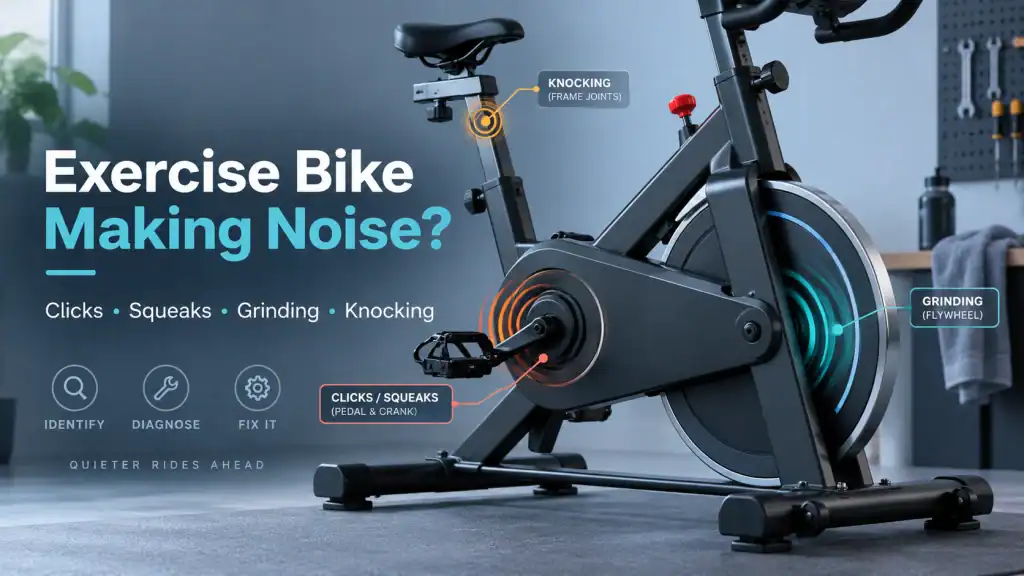
A noisy exercise bike can make the wrong part sound guilty. A click that seems to come from the flywheel may actually start at a pedal and travel through the frame. A squeak that appears only when you stand can come from a stabiliser or frame joint rather than the crank. A rough grind from the front of the bike is more concerning, but even then the sound alone does not tell you whether the problem is a brake, belt, chain, bearing or something rubbing where it should not.
The useful evidence is the pattern. Does the noise happen once per pedal revolution or many times while the flywheel turns? Does it disappear when you sit down? Does it get louder as resistance rises? If you stop pedalling and let the flywheel coast, does the sound continue? Those observations narrow the fault much more reliably than searching for a part that happens to be associated with the word ‘clicking’.
If the bike has a broader fault as well as the noise, start with the exercise bike troubleshooting guide. If the main problem is actual pedal or crank movement, use the pedal-slip guide instead of treating looseness as a sound problem.
Quick answer: If your exercise bike is making noise, first describe the sound and its rhythm before touching anything. A once-per-pedal-turn click sends you towards the pedal, crank, shoe or something moving with the rider. A squeak or creak that appears mainly when you stand often makes stability and assembly joints worth checking. A scrape or grind that continues while the flywheel coasts points farther into the flywheel, brake or drive path. Stop using the bike if the pedals become difficult to turn, resistance changes unexpectedly, a load-bearing joint is loose, the noise is metal-on-metal, or you see belt, chain, crank, flywheel or electrical damage.
In this guide 19 sections
Start with the rhythm, not the part
A stationary bike is a good sound transmitter. The frame, crank axle, covers and floor can carry vibration away from the component that created it. That is why ‘the noise is coming from the front’ is useful, but not enough.
Rhythm is usually more revealing. A noise that happens once every time the right pedal reaches the same position follows crank speed. A faster tick that continues after you stop driving the pedals may follow the flywheel, belt or another faster-moving component. A creak that appears only when body weight shifts from side to side may be coming from the frame, seat, handlebar assembly, stabilisers or even the floor.
This difference is reflected in manufacturer troubleshooting. Schwinn’s IC4 guidance sends a clicking sound while pedalling first to the pedal-to-crank connection. Horizon separates general squeaking or chirping from rough or screeching noise while pedalling, where brake-to-flywheel contact becomes a more serious possibility.
A 90-second noise test before you remove anything
Do this with the bike fully assembled and all guards in place. If the bike already feels unsafe, skip the test and stop using it.
- Ride seated at a light, normal resistance and listen for the sound without deliberately forcing the bike.
- Notice whether it happens once per left or right pedal turn, once per complete crank revolution, or much faster than the pedals.
- If the bike is stable and the noise is not severe, briefly increase resistance. Note whether the sound changes with load rather than just speed.
- If appropriate for your bike and balance, compare seated riding with a short period out of the saddle. A sound that appears only when standing often points towards joints or stability that are being loaded differently.
- Stop pedalling and keep your hands and feet clear while the flywheel naturally coasts. Listen for whether the sound continues.
- Check whether changing resistance alters a scrape or rub. On friction and some magnetic systems, that can tell you whether the brake area deserves attention.
- Finally, remove the rider from the equation. Check the floor, levelling feet, bottle, loose straps, cables, adjustment knobs and anything that can tap or move without opening a guard.
Do not turn the test into a powered inspection with covers removed. If the useful next step requires exposed belts, chains, pulleys, a flywheel or live electronics, use the service procedure for the exact model or hand the diagnosis to a fitness-equipment technician.
What the sound is telling you
| Noise pattern | What it can suggest | First safe checks |
| Click or tick once per pedal turn | Pedal-to-crank connection, pedal body, cleat or strap, crank area, or a rider-loaded joint. | Compare left and right, check visible pedal/crank security, remove loose objects and note whether it changes seated versus standing. |
| Squeak, chirp or creak | Levelling, assembly bolts, seat/handlebar adjustment points, pedal threads or another joint flexing under load. | Check stability and visible hardware. Use lubricant only where the manufacturer specifically calls for it. |
| Scrape or metallic rub | Unwanted contact at a cover, flywheel, brake or another moving part. | Stop if contact is heavy. Note whether the sound changes with resistance or continues while coasting. |
| Grinding, rumbling or roughness | Bearing wear, damaged drive components, severe brake contact or another internal mechanical fault. | Stop strenuous use. If roughness is felt through the pedals or frame, do not keep riding to ‘see if it clears’. |
| Knock, clunk or thump | Loose frame/stabiliser hardware, pedal or crank play, a shifting seat assembly, drive impact or a rotating part with play. | Check which movement makes it happen and whether the bike rocks. Do not keep riding with a visibly loose load-bearing joint. |
| Rattle | Cover, bottle holder, console mast, cable, adjustment pin, loose hardware or an object touching the frame. | Remove loose accessories and check external fasteners before blaming the drivetrain. |
| Smooth whoosh or low mechanical hum | Can be normal on some flywheel, belt, generator or air-resistance systems. | Compare with the manual and with the bike’s previous behaviour. A new harsh sound, vibration or change in pedalling feel matters more than absolute loudness. |
Is the sound actually abnormal?
Not every sound from an exercise bike is a fault. Horizon’s owner guidance makes an important point: on quiet belt-drive magnetic bikes, small mechanical sounds from bearings, belts and rotating parts can be easier to hear because there is less background mechanical noise to mask them. It also notes that some sounds can change slightly during a workout as parts warm.
The room changes what you hear too. A bike on a hard suspended floor can transmit vibration differently from the same bike on a solid, carpeted surface. A nearby wall can reflect sound back towards you. None of that means you should ignore a new click or grind, but it explains why a perfectly healthy bike may sound louder at home than it did in a large showroom.
Air bikes are a separate case. Their fan is meant to create drag, so the rush of air rises sharply with speed. A smooth fan roar is not the same symptom as a new knock, chain clatter, bearing rumble or side-to-side vibration. The expected baseline depends on the mechanism.
Clicking once every pedal revolution
A click that repeats at the same point in the pedal stroke is one of the most useful noise patterns because it tracks something rotating at crank speed. Start outside the frame.
Schwinn IC4 and Bowflex C6 owner guidance specifically points to the pedal-to-crank connection when there is a clicking sound while pedalling. Decathlon uses the same logic on several Domyos exercise bikes, telling owners to recheck pedal and crank installation when the click occurs on each pedal turn.
Before removing a pedal, rule out things that mimic it. A loose toe-cage strap can tap the crank or frame. A cleat can move in the pedal. A shoelace can touch a cover. A bottle can tick in its holder. A saddle rail or seat-post joint can creak once per power stroke because your body loads it at exactly the same point each revolution.
Then compare sides. If the click follows the right foot but not the left, that is stronger evidence than ‘it seems to come from the middle’. If the pedal or crank is physically loose, stop treating this as a noise-only problem.
Use Exercise Bike Pedals Slipping or Skipping? Diagnose Pedal, Crank and Drive Problems for pedal threads, crank play and drive slip. That guide also covers the reverse-thread warning on the left pedal and why repeated tightening is not a cure for a worn interface.
If the click only happens when you stand or push hard
Load changes the diagnosis. Standing puts more force through the pedals, crank, frame and stabilisers, and it shifts your body weight from side to side. That can make a quiet joint start clicking even though it is silent during easy seated pedalling.
This is where owner communities are useful as a pattern check rather than a parts catalogue. Peloton owners have reported clicking that sounded like a crank or bottom bracket but disappeared after loose stabiliser hardware or levelling points were corrected. Other riders with similar sounds really did need drivetrain service. The lesson is not that ‘Peloton clicks are stabilisers’. It is that frame-borne sound is deceptive, so prove the external joints before ordering an internal part.
Squeaking, chirping or creaking
A squeak is often produced by two surfaces moving minutely against each other. On an exercise bike that can happen at an assembly bolt, a seat or handlebar adjustment point, a pedal thread, a stabiliser or another joint that flexes with each stroke.
Horizon currently tells owners with a squeaking or chirping bike to verify that the machine is level and to revisit the bolts installed during assembly. Decathlon similarly tells owners of several current Domyos bikes to check visible screws and bike stability before looking deeper.
That is a better first step than spraying lubricant at the sound. A squeak caused by a moving frame joint will not be fixed properly by coating a nearby cover. A squeak from a foot strap or shoe is not a bearing problem. And a friction-resistance bike has a braking surface near the flywheel that should not be contaminated with a random spray.
Why the bike may squeak only after ten minutes
A sound that appears after the bike warms up is not automatically a failed bearing. Temperature, load and repeated frame movement can change clearances and make a previously quiet joint audible. Horizon’s general bike guidance specifically notes that mechanical sounds can change as parts warm.
Use the timing as another clue. Does the noise arrive after a certain duration regardless of resistance, or only after you increase load? Does it disappear once you sit down? Does the bike also become rougher to pedal? The more the symptom includes resistance change, roughness or heat, the less comfortable you should be treating it as a harmless squeak.
Grinding, scraping or screeching needs more caution
Grinding is not just a louder squeak. If you can feel roughness through the pedals or frame, the bike becomes difficult to turn, or the noise sounds like hard contact between rotating parts, stop the workout.
Horizon has a separate current support path for noise and rough feel while pedalling. One fault it identifies is a magnetic brake rubbing the flywheel. In the severe case it describes, the pedals can become very difficult to move and a screeching sound may be heard. Horizon’s instruction there is to contact technical support rather than keep riding or improvise an adjustment.
Other internal possibilities include a worn or misaligned drive belt, a chain problem on chain-driven bikes, bearing damage, a shifted flywheel, a damaged idler or a cover that has moved into contact with a rotating part. Those faults can sound surprisingly similar through a closed shroud.
The safe owner-level job is to identify the pattern. Does the scrape change as resistance changes? Does it continue while the flywheel coasts? Is the flywheel visibly contacting a guard from a safe external view? Is there belt dust, fraying, metal debris or another sign the machine is wearing itself away? Once the answer requires a hand near an exposed moving system, stop.
A grind plus heavy pedalling is not a ‘noise only’ fault
If the bike becomes much harder to pedal at the same time the grinding begins, resistance or internal mechanical drag has changed. That combination matters more than the sound.
If the selected resistance is behaving incorrectly, use Exercise Bike Resistance Not Working? Diagnose the Cause Before Replacing Parts. Do not try to silence the grind by adjusting resistance calibration or belt tension from another model.
Knocking, clunking and thumping
A dull knock often comes from movement rather than friction. Check whether the bike rocks on the floor, whether a stabiliser shifts, whether the seat or handlebar assembly moves under body weight, and whether a pedal or crank has play. A clunk that appears only as you reverse load through the pedals can point towards a joint taking up clearance.
A thump once per revolution can also come from a rotating component with damage or eccentric movement, but do not jump straight to the flywheel. Exercise-bike frames carry impact well. Something loose at the rear stabiliser can sound as though it is under the crank.
If the noise is new after a house move, treat that history as evidence. The bike may now be on a different floor, the levellers may no longer be set correctly, or a pedal, mast, handlebar or stabiliser may have been disturbed for transport.
Use the coast test to separate crank-speed noise from flywheel-speed noise
One of the most useful low-risk observations is what happens when you stop driving the pedals and allow the flywheel to slow naturally, provided your bike is designed to coast and the test can be done without reaching towards moving parts.
If the noise stops almost immediately with your pedal movement, the pedal, crank, shoe, seat or rider-loaded frame path moves higher on the list. If the sound continues while the flywheel is still spinning, look farther down the drive path towards the belt, chain, pulley, flywheel, brake or bearings.
This is not absolute. Some indoor cycles use fixed-gear style drivetrains where the pedals continue to move with the flywheel, and some freewheel designs behave differently. Know how your model works before using a coast test as a diagnostic shortcut.
A noise that changes with resistance
Resistance is another useful variable. On a friction bike, the brake pad deliberately contacts the flywheel, so its sound can change as pressure changes. On a magnetic bike, the magnets normally do not touch the flywheel. A new metallic scrape that grows with a resistance change is therefore not something to dismiss as ‘magnetic resistance noise’.
On electronically controlled bikes, a short actuator sound while resistance changes can be normal for the design. The important distinction is whether the sound is the normal brief movement of the mechanism or a new persistent grind, buzz, repeated hunting motion or physical rub.
If the noise arrives together with resistance that is stuck, erratic, too heavy or too light, diagnose the resistance fault first. A resistance system that is physically rubbing can damage both the brake and flywheel if you continue riding through the noise.
A rattle may be much simpler than it sounds
Rattles often create the most dramatic apparent ‘internal’ noise because thin plastic covers amplify them. Before opening anything, remove or secure bottles, phone holders, loose cables, dumbbells, straps and accessories. Check that adjustment pins are fully engaged and that the console mast or handlebar does not have visible movement.
A plastic cover can also buzz against the frame only at a certain cadence. If the bike otherwise feels normal, locate the sound with the machine stopped and unpowered rather than pushing on the cover while the flywheel is moving.
If the noise began immediately after assembly
A new bike that has been noisy from its first ride deserves an assembly audit before a wear diagnosis. Pedals can be installed on the wrong side or started crooked, a stabiliser can be uneven, a frame bolt can be under-tightened, a shipping spacer can be left where the manual says to remove it, or a cable or cover can be routed against something that moves.
Schwinn warns that its IC4 pedals must start straight in the crank by hand and that the left pedal uses a reverse thread. Decathlon repeatedly places visible hardware, pedal seating and stability near the start of its noise troubleshooting. That is exactly where a new-bike diagnosis should begin.
Do not compensate for uncertain assembly by simply applying more force to every fastener. Some joints have a specified torque, some use locking hardware, and some plastic components can crack if over-tightened. Follow the exact manual.
Do not ‘lubricate the noise’ until you know what is moving
Generic noise advice on the web often ends with ‘add lubricant’. That is too broad for exercise bikes.
A chain-drive indoor cycle may have a manufacturer-specified chain maintenance procedure. A pedal thread may call for grease during installation. An assembly bolt may have a manufacturer-approved thread treatment. But a belt-drive bike does not automatically need its belt sprayed, sealed bearings are not serviced by coating the outside, and a friction brake surface should not be contaminated.
The same caution applies to community fixes. Owners sometimes report that a general spray or dry lubricant quieted a click. That does not prove the product reached the actual fault or that the same treatment is safe on another bike. Silence is not evidence of a correct repair if a joint is still loose or a braking surface has been altered.
When a technician can isolate the noise more accurately
Once external hardware, levelling, pedal installation, rider contact and obvious interference are ruled out, deeper diagnosis becomes much easier if the drive components can be separated safely.
Sunny Health’s current cycle-bike noise procedure illustrates the technician logic: isolate the pedals, crank, belt, flywheel axle and belt-wheel axle step by step so the sound can be tied to one rotating assembly. That is good diagnostic reasoning, but several of those checks involve removing drive covers or belts. They should only become owner procedures when the exact model’s instructions say they are.
A technician can also check bearing play, belt tracking, pulley alignment, bottom-bracket condition, brake clearance and flywheel runout without guessing from the noise alone. A phone video recorded from both sides of the bike can be surprisingly helpful when booking support, especially if it captures cadence, resistance level and whether you are seated or standing.
When to stop using the bike
A mild, known creak from an adjustment point is different from a developing mechanical failure. Stop riding and arrange inspection when any of the following appears with the noise:
- A pedal, crank arm, seat, handlebar or stabiliser is visibly loose under load.
- The pedals suddenly become difficult to turn, jam or slip.
- Resistance changes on its own or no longer responds normally.
- There is persistent grinding, metal-on-metal scraping or a heavy knock that is getting worse.
- A belt, chain, pulley, flywheel or cover is visibly damaged, frayed or contacting another part.
- You smell burning material, see smoke, feel unusual heat near an electrical component or see damaged wiring.
- The bike rocks enough to lift a foot or stabiliser from the floor.
- The next diagnostic step requires powered operation with a guard removed.
Frequently asked questions
Why is my exercise bike clicking every time I pedal?
A once-per-pedal-turn click often follows something moving at crank speed. Start with the shoe or strap, pedal-to-crank connection, pedal body, crank area and rider-loaded seat or frame joints. Schwinn and Decathlon both use pedal/crank installation as an early check for this symptom. If anything is physically loose or slipping, move to the dedicated pedal and crank guide.
Why does my exercise bike squeak when I stand up?
Standing increases force through the pedals, crank, frame and stabilisers while shifting body weight side to side. Check that the bike is level and stable, then inspect visible assembly hardware, seat and handlebar adjustment points and pedal security. Do not assume a bottom bracket or bearing until the external loaded joints are ruled out.
Why is my stationary bike grinding when I pedal?
Grinding or roughness can come from brake contact, bearings, belt or chain problems, a damaged rotating component or another internal part rubbing. If the pedals are also harder to turn or the grind is felt through the frame, stop riding. Horizon specifically treats severe brake-to-flywheel rubbing with difficult pedalling and screeching as a service issue.
Is a magnetic exercise bike supposed to be silent?
Not completely. Magnetic resistance removes the deliberate friction-pad contact used by friction bikes, so it can be very quiet, but belts, bearings, flywheels and frame vibration still make some mechanical sound. What matters most is a new or worsening noise, especially when it comes with vibration, roughness, resistance change or looseness.
Can I use WD-40 or another spray on a squeaky exercise bike?
Not as a generic fix. Exercise bikes contain different belts, chains, bearings, bushings and braking surfaces. Use only the lubricant or thread treatment specified for the exact component in the manufacturer documentation. Never spray an unknown product towards a friction brake, drive belt, electrical assembly or sealed bearing simply because the noise seems nearby.
Why does my bike sound louder at home than it did in the shop?
The room can amplify or transmit vibration differently. Hard floors, suspended timber floors and nearby walls can make mechanical sound or low-frequency vibration more obvious than in a large showroom. Check levelling and stability, and compare the type of sound rather than the absolute volume alone.
Does a clicking noise mean the bottom bracket is bad?
No. A bottom bracket can click, but so can pedals, cleats, crank connections, stabilisers, seat hardware and other loaded joints. Community repair histories repeatedly show that the same apparent crank-area click can have different causes. Prove the easy external sources before replacing an internal bearing assembly.
Why does the noise continue after I stop pedalling?
If your bike’s flywheel continues to coast after you stop driving the pedals and the noise continues with it, the sound is less likely to come solely from a rider-loaded seat joint or a pedal that has stopped moving. The drive, flywheel, brake or rotating bearings become more relevant. Fixed-gear style indoor cycles behave differently, so confirm how your model’s drivetrain works.
My new exercise bike is making noise. Should I return it?
First check the exact assembly and support guidance while the bike is still within its return or warranty window. A new-bike noise can be something simple such as levelling, pedal installation or loose assembly hardware, but it can also indicate a defective or damaged component. Record the sound and contact the retailer or manufacturer before doing any repair that could affect warranty coverage.
The bottom line
The best way to diagnose an exercise bike making noise is to stop asking only where it sounds loudest. Ask what the noise follows.
A click once per pedal turn, a creak only when you stand, a scrape that changes with resistance, a grind that continues while the flywheel coasts and a rattle from a loose accessory are different fault paths. Start with rhythm, load, stability and the coast behaviour. Check the safe external causes. Then stop when the evidence points behind a guard or into a model-specific service procedure.
That approach may feel slower than ordering a bearing or spraying lubricant, but it is much more likely to find the actual source without damaging a belt, brake, crank or warranty in the process.
Related FixDecoded guides
• Exercise Bike Troubleshooting: Diagnose Resistance, Console, Pedal and Noise Problems – Use the cornerstone when the bike has several symptoms or the main fault is still unclear.
• Exercise Bike Resistance Not Working? Diagnose the Cause Before Replacing Parts – Use this when the noise is accompanied by fixed, erratic, too-heavy or too-light resistance.
• Exercise Bike Console Not Working? Diagnose a Blank, Frozen or Stuck Display – Use this when the display, power, speed or RPM data is the primary fault.
• Exercise Bike Pedals Slipping or Skipping? Diagnose Pedal, Crank and Drive Problems – Use this when a pedal or crank is physically loose, wobbly, slipping or losing drive under load.
Sources and further reading
• Horizon Fitness: Bike Squeaking or Chirping – Current 2026 manufacturer support covering levelling and assembly-bolt checks for squeaking or chirping.
• Horizon Fitness: Noise While Pedaling – Current 2026 manufacturer guidance separating rough/screeching brake contact from levelling and loose assembly hardware.
• Horizon Fitness: Exercise Bike, Indoor Cycle, Ascent Trainer and Rower Troubleshooting – Manufacturer troubleshooting index used to keep noise, resistance, display and pedal symptoms in separate diagnostic paths.
• Decathlon UK: Domyos EB 120 support – Official guidance linking squeaking with visible hardware/stability and once-per-pedal-turn clicking with pedal/crank installation.
• Decathlon UK: Initial Bike support – Official support for visible hardware, stability and pedal/crank clicking checks.
• Schwinn Fitness: Product Manuals – Manufacturer manual directory. Current IC4/800IC owner guidance was checked for pedal-to-crank clicking, levelling and drivetrain troubleshooting.
• Bowflex C6 Assembly / Owner’s Manual mirror – Owner guidance confirming a clicking sound while pedalling is first checked at the pedal-to-crank connection.
• Sunny Health & Fitness: Cycle Bike Noise Troubleshooting – Manufacturer diagnostic sequence showing how deeper service work isolates pedals, crank, belt, flywheel and axle noise.
• Peloton: Hardware Troubleshooting – Noises on Bike/Bike+ – Official manufacturer noise-support entry used as a brand-specific support reference.
• Keiser M Series Support – Manufacturer support portal illustrating the value of model-specific maintenance, service bulletins and calibration procedures.
Community pattern checks
Community sources were used to understand how owners describe faults and where generic advice goes wrong. They were not used as the sole authority for repair instructions.
• Reddit /r/pelotoncycle: Peloton has clicking noise – Shows the same apparent crank-area click being associated with different causes, including stabiliser hardware and bottom-bracket service.
• Reddit /r/pelotoncycle: Clicking sound while pedaling solution – Owner/technician experience showing external stabiliser hardware can imitate an internal drivetrain click.
• Reddit /r/SchwinnIC4_BowflexC6: Play in left pedal – Owner reports used to distinguish pedal-body play from a pedal-to-crank joint that is already tight.
• Bike Forums: Constant noise from Kettler exercise bike – Community troubleshooting illustrating how a rhythmic sound can be mislocated and why visible belt wear/alignment matters more than guessing from sound alone.
• Keiser M3i verified-owner reviews – Owner reports reviewed to compare normal quiet operation with recurring clicking and rubbing descriptions. Diagnostic claims were not taken from reviews.