
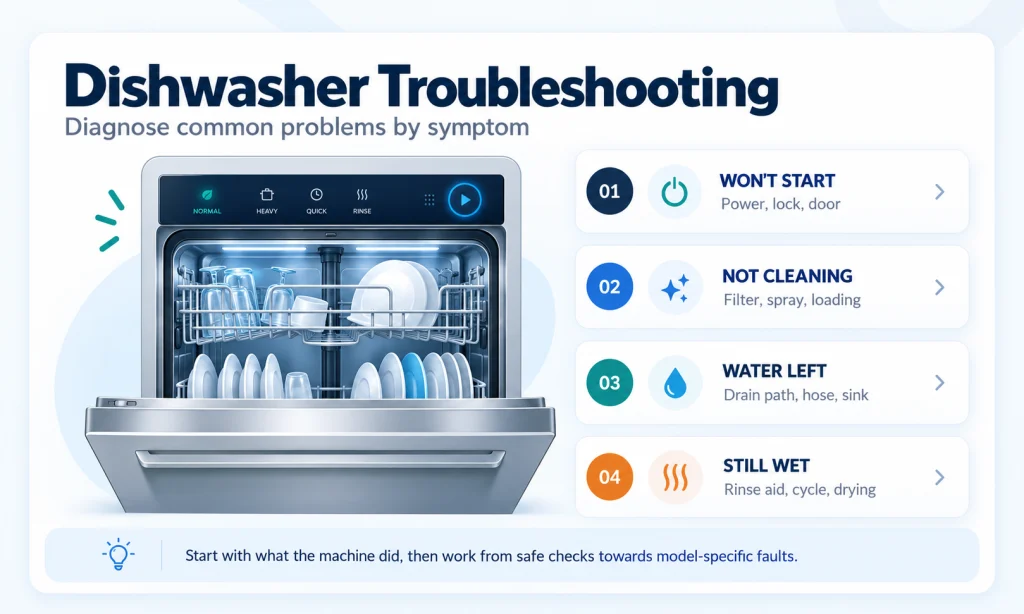
A dishwasher can finish one bad cycle and make it look as though half the machine has failed. You open the door and find a mug on the top rack still dirty, gritty residue on a plate, a detergent pod stuck near the dispenser and water around the filter. Everything is wet. There may be a smell as well.
Those symptoms may be connected.
A dishwasher works through a sequence. It starts, fills, circulates wash water, drains, rinses and dries. If one stage fails, the next stage may never work properly. A machine that does not fill enough can wash badly and leave detergent behind. A machine that cannot drain can stop before drying. Poor circulation can make one rack look much worse than the other.
Good dishwasher troubleshooting starts with the sequence, not the suspected part. The useful starting point is not, “Which part has failed?” Start with what the dishwasher actually did.
Quick answer: Identify the first stage that went wrong. If the dishwasher is completely dead, start with power, controls and the door. If it fills but leaves dirty dishes, check loading, filters, spray arms and water circulation. If water remains after the cycle, trace the drain path from the filter to the household plumbing before blaming the pump. If dishes are clean but wet, troubleshoot drying separately. If it leaks, note when the leak starts and where the first water appears.
Safety first: Stop using the dishwasher if it repeatedly trips a breaker, RCD or GFCI, smells electrically burnt, produces smoke or sparks, leaks towards wiring or an outlet, or continues filling when it should have stopped. Turn off the electrical supply and shut off the water before working on hoses or accessible internal parts. Do not bypass the door switch, float, earth/ground connection or another safety device. Live electrical testing and repairs that require energised parts to be exposed belong with a qualified technician.
Start with the first stage that failed
The same component can affect more than one stage, so diagnose the behaviour before naming a part.
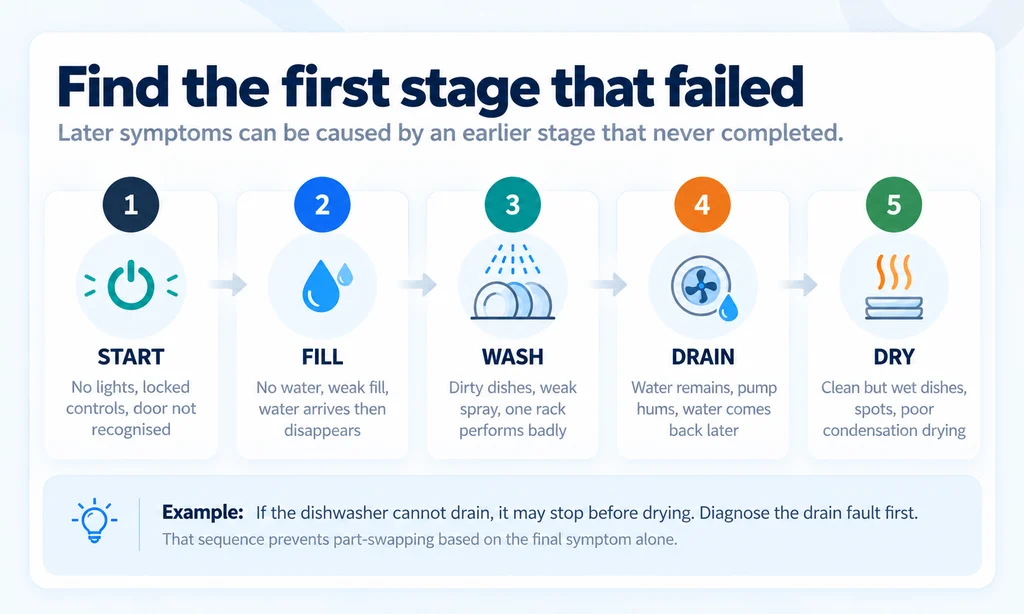
Figure 1. Find the first stage that failed. Later symptoms can be caused by an earlier stage that never completed.
| What you notice | Where to look first |
| No lights or response | Power supply, breaker/RCD/GFCI, plug or hard-wired connection |
| Lights work but the cycle will not start | Door closure, control lock, delay start, interrupted cycle |
| Dishwasher starts but does not fill | Water supply, inlet hose, float or fill system |
| Dishes remain dirty | Loading, filter, spray arms, detergent, water level and circulation |
| Bottom rack cleans but top rack does not | Upper spray arm, rack water connection, feed tube, diverter or restricted circulation |
| Detergent remains in the dispenser | Blocked dispenser door, weak spray, poor fill or low circulation |
| Water remains after the cycle | Filter, sump, drain hose, air gap, sink/disposer connection or drain pump |
| Water drains, then returns later | Backflow from the sink/drain system, drain-hose routing, or less commonly fresh-water seepage through the inlet side |
| Water leaks from the front | Suds, obstruction at the door, gasket, levelling, loading or misdirected spray |
| Water appears underneath | Supply connection, drain hose, inlet valve, sump, circulation assembly or pump seal |
| Dishes are clean but still wet | Cycle choice, rinse aid, loading, drying design or heating |
| Dishwasher smells bad | Filter, sump, spray arms, standing water or drain connection |
| Rhythmic knocking | Spray arm striking a dish or utensil |
| Humming but water does not drain | Drain restriction, debris near the pump or pump fault |
| White film or cloudy glasses | Water hardness, detergent dose, rinse aid, glass etching or a softener setting |
| Dishwasher stops part-way through | Door interruption, drainage, power interruption or an error condition |
| Cycle suddenly takes much longer | Programme choice, heating, sensing, repeated filling/draining or a fault condition |
One detail is worth checking before anything else: what changed immediately before the problem started?
A newly fitted dishwasher that has never drained properly should make you think about installation. A dishwasher that stopped draining after a new food-waste disposer was fitted points towards the drain connection. Poor cleaning that started after the filter was removed for cleaning may be caused by a filter or pump cover that was not seated correctly. A top rack that suddenly stopped cleaning after the rack height was adjusted may not be docking properly with its rear water feed.
The fastest shortcuts when something recently changed
| What changed | Check before buying a part |
| New dishwasher or recent installation | Pinched drain hose, water valve, power connection, drain routing, disposer knockout plug where applicable |
| New food-waste disposer or sink plumbing | Disposer inlet plug, drain-hose connection, air gap/high loop and downstream blockage |
| Dishwasher was pulled out or moved | Crushed supply/drain hose, cabinet alignment, levelling, door latch, rack feed connection |
| Filter or pump cover was recently cleaned | Filter seating, pump cover seating, debris left in sump |
| New detergent or tablets | Correct product, dose, dispenser obstruction, sudsing, water temperature and hardness |
| Only the top rack changed | Upper arm, rack docking point, feed tube, cracked spray arm or diverter path |
| Problem appeared after a power cut | Preserved error code, incomplete cycle, control reset procedure in the manual |
| Smell appeared after sink work | Drain backflow, high loop/air gap, trap or sink blockage |
These clues are often more useful than the age of the machine.
Before you reset it, collect the evidence
Power cycling is useful sometimes, but it should not be the first move.
If the display shows a code, photograph it. Note whether the dishwasher was filling, washing, draining or drying when it stopped. Listen for the sounds it still makes. If there is standing water, note whether it is clean or dirty and whether it was there immediately after the programme ended or appeared later.
Then find the model number. Dishwasher procedures vary more than generic troubleshooting pages suggest. Filters, pump covers, rack feed systems, water-softener settings, reset procedures and error codes are model-specific.
Check the kitchen sink as well. A dishwasher shares more plumbing with the sink than many owners realise. If the sink drains slowly, backs up or has just been worked on, that information belongs in the dishwasher diagnosis.
The dishwasher will not start
First separate a completely dead dishwasher from one that has power but refuses to begin a programme.
In this guide 16 sections
No lights, display or sounds
Check the supply outside the appliance first.
Confirm that the relevant breaker, fuse, RCD or GFCI has not tripped. If the dishwasher uses a plug and the plug is safely accessible, make sure it is fully seated and that there is no heat, scorching or damage around the socket.
Do not repeatedly reset electrical protection if it trips again when the dishwasher starts. A second trip is evidence of a fault, not a nuisance to keep resetting.
A hard-wired dishwasher may need an electrician or appliance technician if the supply itself needs testing.
The panel works but the dishwasher will not run
This usually points somewhere different.
Check whether Control Lock or Child Lock is active. Cancel any delay-start setting. Open the door, make sure both racks are fully home, then look for a pan handle, chopping board or utensil preventing the door from closing properly.
Some machines require Start or Resume to be pressed again after the door has been opened during a cycle. GE and Whirlpool both document models where an interrupted door state, Delay Start or Control Lock can make a healthy dishwasher appear unwilling to start.
Listen to the latch. A door can appear closed but still fail the dishwasher’s safety check. On a recently installed integrated model, cabinet alignment can also stop the door from seating correctly.
If the display behaves normally but the dishwasher never recognises a firmly closed door, the latch, door switch, alignment or related wiring becomes more relevant.
Do not bypass the switch to make the dishwasher run.
The dishwasher is not filling with water
A no-fill problem is easier to narrow down if you listen to the first minute of the programme.
Make sure the dishwasher’s water isolation valve is open. Inspect the inlet hose for a sharp bend or crushing. If the problem began after plumbing work, remember that a valve can be left partly closed and sediment can enter a small screen or valve assembly.
If your dishwasher has an owner-accessible overfill float inside the tub, check that it is not physically trapped in the raised position by debris. Whirlpool specifically lists a restricted overfill float as a no-fill cause on models that use one. Never hold the float down or defeat its switch.
Also consider siphoning. A drain hose installed incorrectly can let water leave while the dishwasher is trying to fill. Exact drain heights and routing differ by model and region, so use the installation instructions rather than copying one universal measurement from a forum post.
A machine that makes an unusual grinding or circulation sound while the tub remains almost dry is telling you something different from a dishwasher that remains completely silent.
If the external supply is correct but the dishwasher still cannot fill, the inlet valve, float/pressure sensing, flow system or control side may need model-specific diagnosis.
It fills, but the dishes still come out dirty
Poor cleaning causes some of the worst troubleshooting rabbit holes because owners often change detergent repeatedly before checking whether water can actually reach the dishes.
Start inside the tub.
Remove and clean the filter exactly as the manual describes. Bosch, LG, Whirlpool and AEG all place filter condition high on their poor-cleaning checklists. A filter can look acceptable from above while grease and fine debris are packed into the mesh below.
Do not assume every dishwasher has the same removable filter arrangement. Some models use different filtration systems. If the manual does not show an owner-removable filter, do not dismantle the sump looking for one.
Then check the spray arms. Turn each owner-accessible arm by hand. It should move without striking plates, pan handles or cutlery. Inspect the spray openings for food fragments or mineral deposits. Bosch recommends loosening debris with a toothpick; LG describes cleaning blocked nozzles according to the model instructions. Use the method your manual permits rather than forcing a metal tool into a small jet.
This is a very real failure pattern. In owner discussions, people describe cleaning filters, changing detergent and running maintenance cycles only to find seeds, rice or other debris packed inside a spray arm. One 2026 KitchenAid owner with recurring undissolved pods traced the problem to heavily clogged spray-arm holes. Once the arms were cleared, the stronger spray also solved the detergent problem.
Loading matters too. Water has to reach the dirty surface. Bowls nested together, a large chopping board across the lower rack or a tall pan blocking a middle spray arm can create a perfectly repeatable “fault” without anything being broken.
Scrape away large food scraps before loading. Routine pre-rinsing is not required by many current manufacturers, but burnt-on food, dried egg and unusually heavy soil may still need soaking or pre-treatment. Follow your machine and detergent guidance rather than treating every load the same way.
Then look at detergent. Use detergent made for automatic dishwashers and keep it dry. Damp powder, degraded tablets or a dispenser that cannot open properly can all reduce wash performance.
If cleaning remains poor after the filter, loading, spray arms and detergent have been checked, pay attention to how much water is entering and how strong the circulation sounds. Weak circulation can come from restricted water supply, a circulation-pump problem or, on some designs, a diverter system that is not sending water where it should.
If the dishes feel gritty or sandy
Grit after a cycle often means material was loosened but not carried away properly.
Check the filter and sump first. Then inspect the spray arms for debris that could be recirculating. Make sure the filter is locked back into position correctly. A loose or incorrectly seated filter can allow particles to move around the tub instead of being trapped where the design expects them.
If the grit is white and chalky rather than food-like, move to the water-hardness section below. Mineral film and recirculated food debris need different fixes.
The bottom rack cleans but the top rack stays dirty
Treat this as its own symptom.
If the lower rack washes properly, the dishwasher clearly has some water and some circulation. The question becomes why the upper spray system is not getting the same result.
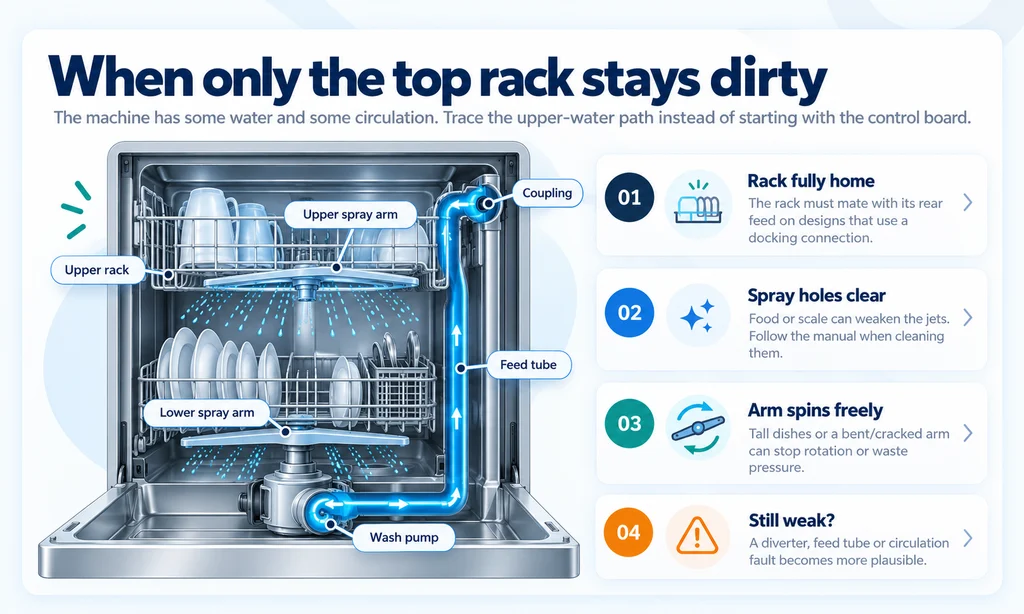
Figure 3. When only the top rack stays dirty, trace the upper-water path before blaming the whole circulation system.
Pull out the upper rack and inspect its spray arm. Check the jets and make sure the arm rotates freely.
Then look at how the rack receives water. On many designs, pushing the rack fully home mates a tube or port on the rack with a water feed at the rear of the tub. A rack that is not seated correctly can leave the upper spray arm starved of water even though the lower rack looks normal.
Make sure tall items below are not physically stopping the arm. Also inspect the arm itself for a split seam or crack. A cracked arm can leak pressure in the wrong direction and still look normal when dry.
A useful low-risk test is to note the spray-arm position before a programme and check whether it has moved afterwards. This is not a pressure measurement, and some machines alternate spray zones rather than running every arm continuously, but an arm that repeatedly never changes position gives you another clue.
If the upper path is clear but there is still very little pressure while the lower rack performs normally, a feed-tube, diverter or circulation fault moves higher on the list. That is where the exact model becomes important.
The detergent pod or powder is still in the dispenser
A half-intact pod is evidence. Do not simply add a second one next time.
First check whether the dispenser opened.
If the tablet is still trapped behind a closed flap, make sure the compartment was dry when loaded and that nothing in the rack was blocking the lid. Tall trays and chopping boards can sit directly in front of the dispenser and prevent it opening fully.
Clean detergent build-up around the dispenser. Samsung specifically lists residue around the mechanism, low water temperature, blocked spray movement and dishes obstructing the dispenser as causes of detergent that does not dispense or dissolve.
If the dispenser opened but the pod is sitting partially dissolved inside the tub, look at water and circulation. Make sure the dishwasher filled properly, the spray arms can move and the dispenser has a clear line of spray.
Owners often assume that an undissolved pod means the water was not hot enough. Temperature can matter for some tablets, but a pod repeatedly left in the same place can also be a circulation clue. The 2026 owner case mentioned above is a good example: clogged spray-arm holes weakened the jet reaching the dispenser.
If pods repeatedly fail while overall cleaning is poor, treat the two symptoms as related until you have evidence otherwise.
The dishwasher is not draining
Standing water is one of the most misunderstood dishwasher symptoms.
First decide how much water you are seeing and where it sits. GE documents that a small amount of water in the sump or, on some older designs, one to two cups in the bottom of the tub can be normal. Water spread across the tub floor or rising towards the door is different.
If there is clearly too much water, switch off power before putting your hands into the drain area.
Remove the lower rack and clean the filter if your model has an owner-serviceable one. Inspect the accessible sump for labels, bones, broken glass, fruit stones or other debris. Wear gloves and use caution because sharp fragments can sit where they are difficult to see.
Next, follow the drain path outside the dishwasher.
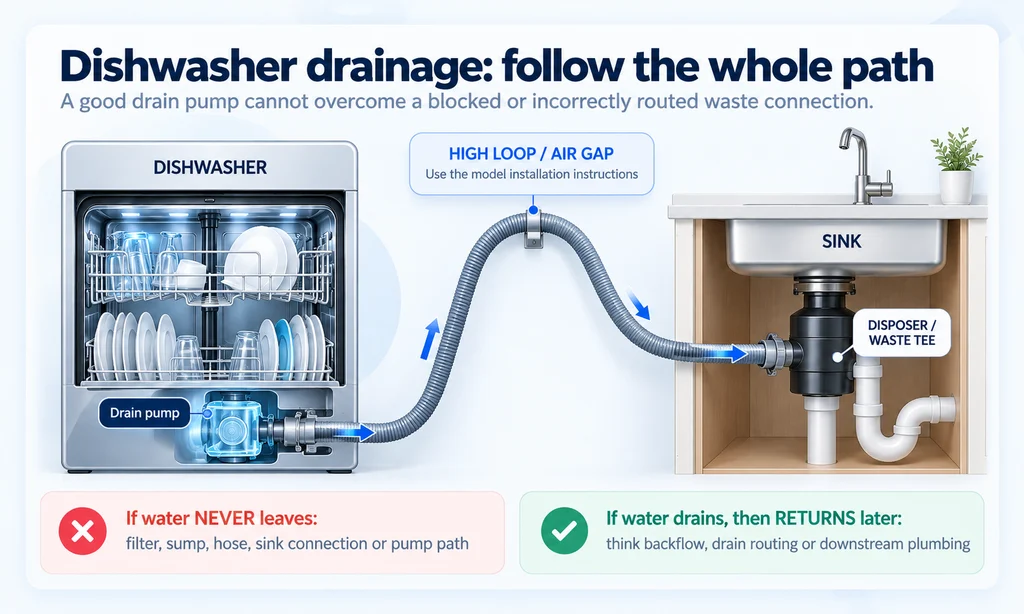
Figure 2. Follow the entire drain path. Water that never leaves and water that drains then returns are different diagnostic problems.
Check the hose under the sink for kinks or crushing. Look at the point where it joins the sink waste, air gap or food-waste disposer.
If the problem began immediately after a new disposer was installed, check the installation instructions. Many disposer connections in North American installations contain a knockout plug that must be removed before a dishwasher can drain into them. Whirlpool and Samsung both call this out because a forgotten plug can make a new dishwasher look as if its pump has failed.
Run the kitchen sink and see how well it drains. If the sink itself is slow, the dishwasher may be pumping correctly into restricted household plumbing.
Where the installation uses an air gap, check it as the manufacturer describes. Where the dishwasher requires a high loop in the drain hose, make sure the hose is routed exactly as the installation instructions specify. Requirements vary by model and local plumbing rules.
Listen during a drain attempt. A strong pump sound with little or no water leaving can point towards a restriction or jammed pump path. Complete silence points somewhere else, but it does not prove the pump is faulty because the control system may not be commanding it to run.
Do not pour household drain-opening chemicals into the dishwasher. Whirlpool specifically warns against doing this because they can damage components and create a safety hazard.
It drains, then water mysteriously comes back later
This is one of the most valuable timing clues in dishwasher troubleshooting.
If the tub is empty when the cycle finishes but contains dirty or foul-smelling water a few hours later, do not immediately replace the drain pump. The dishwasher has already shown that it can pump water out.
Think about backflow.
Water from the sink or waste plumbing may be travelling back through the dishwasher drain hose. A missing or poorly arranged high loop, blocked air gap, restricted sink drain or unsuitable connection can contribute, depending on the installation.
This comes up repeatedly in plumbing and appliance forums because the dishwasher may drain perfectly during the programme. The water appears later, often after the sink or disposer has been used.
There is another version of the symptom: clean water slowly appears even when the sink has not been used. If you can establish that the water is fresh supply water rather than drain water, the inlet side becomes more interesting. A water inlet valve that does not close fully can allow a slow seep into the tub even while the dishwasher is off. Shut off the appliance water supply if the level keeps rising, especially if there is any risk of overflow, and arrange model-specific repair.
The colour, smell and timing of the returning water matter.
The dishwasher is leaking
Do not keep running full programmes while investigating a significant leak.
Dry the area first. Then use the location and timing of the first water to narrow the possibilities. The puddle can travel along a cabinet or hose and appear far from the original leak.
Water from the front or door corners
Open the door and inspect the gasket for food, damage or a section that has pulled out of position. Check for a utensil or rack item interfering with the seal.
Make sure the dishwasher is installed squarely and reasonably level. Misalignment can affect door closure.
Then look for foam.
Hand washing-up liquid or hand dish soap creates far more suds than automatic dishwasher detergent. Excess foam can escape around the door and make a sound gasket look faulty. Spilt rinse aid can also create excessive foaming on some machines if a large amount is left in the tub.
Check the spray arms too. LG includes blocked or damaged spray arms in its leak troubleshooting because a damaged arm can direct water where the tub and door system were not designed to receive it.
Water underneath the dishwasher
A leak from underneath deserves more caution because electrical parts may also be present.
Possible sources include the inlet connection, water supply line, drain hose, inlet valve, sump area, circulation assembly or pump seals.
The timing helps. Water appearing while the machine fills points towards the supply and fill side. A leak that appears mainly while draining makes the drain hose and related connections more interesting. Water from the centre beneath the tub can indicate an internal seal or sump problem.
If locating the leak requires running the dishwasher with panels removed or working near live wiring, stop there.
The dishwasher cleans properly but will not dry
Wet dishes do not automatically mean the heater has failed.
First look at what is wet. Plastic containers commonly retain more water than ceramic plates, glass or metal because they cool quickly. Samsung and LG both point out that plastics often dry less completely on condensation-drying machines.
Check the selected programme. Eco, quick or air-dry options can behave differently from a heated, sanitize or extended-dry option.
Make sure the rinse-aid dispenser is filled if the dishwasher is designed to use it. Rinse aid reduces surface tension so water sheets off rather than clinging in large droplets. Bosch, Samsung, LG, AEG and Electrolux all recommend it for better drying performance.
Loading affects drying as well. Angle mugs, bowls and containers so they do not collect pools of water. Give items enough space for water to drain.
Some modern dishwashers use condensation drying or automatically crack the door towards the end of the programme rather than relying on an exposed heating element. Do not assume your machine should behave like an older dishwasher.
A more useful clue is whether an entire completed load remains unusually cold and wet when the selected programme should have heated the water. If there is no evidence of heat at all, the cycle ends prematurely or the dishwasher reports a heating-related error, service may be required.
The dishwasher smells bad even after cleaning
Running another cleaning cycle is not always the answer.
Pull the filter and inspect it physically. Check the sump below it. Look at removable spray arms where the manual allows. Food trapped in these areas stays wet between cycles and can produce a strong odour.
Clean the door edges and seals as well. Water and residue can collect outside the main spray pattern.
Then consider the drain. A dishwasher that smells fine immediately after cleaning but develops an unpleasant odour after the kitchen sink has been used may be receiving drain water back through its hose. A poor high loop, blocked air gap or plumbing restriction can therefore look like a cleaning problem.
Recent plumbing discussions show exactly this pattern: owners repeatedly clean the filter and tub, yet the smell returns until the drain hose routing or backflow problem is corrected.
If the smell is coming from the household drain itself, repeatedly sanitising the dishwasher will not repair the plumbing.
Use cleaners approved for the appliance. Never mix chlorine bleach with vinegar, citric acid, ammonia or another household cleaner.
The dishwasher is suddenly noisy
Dishwashers are not silent machines, and some noises that sound mechanical are completely normal.
Humming during circulation or draining can be normal. Clicking can occur as valves, controls or the detergent mechanism operate. Swishing is water moving around the tub.
A rhythmic knock or thump deserves a loading check. Turn the spray arm by hand and see whether it hits a plate, pan handle or utensil.
Rattling that disappears when the dishwasher is run empty also points towards the load rather than the motor.
A harsh grinding sound while the tub has little or no water is different. It can accompany a fill problem or a pump operating under abnormal conditions. Grinding during drainage can also be caused by hard debris in or near the drain pump.
If the sound is new, severe and rapidly worsening, stop repeatedly testing it. A small piece of glass is cheaper to remove than a pump it eventually damages.
White residue, spots or cloudy glasses
Do not treat every cloudy glass as the same problem.
Hard-water minerals and detergent residue can leave a removable film. Etching is physical or chemical damage to the glass surface and is permanent.

Figure 4. A small vinegar spot-test can help separate removable film from likely permanent glass etching.
Whirlpool recommends a simple distinction: gently rub a small cloudy area with a little white vinegar. If the film lifts, mineral or detergent film is likely involved. If it does not, the surface may be etched or affected by another permanent film.
Water hardness matters in both directions. Hard water can leave mineral deposits and reduce cleaning performance. Very soft water combined with too much detergent can contribute to glass etching.
If your dishwasher has a built-in water softener and salt reservoir, set the hardness level to match the actual water supply. AEG and Electrolux emphasise that the softener setting should be matched to local hardness. Use dishwasher salt only in machines designed for it. Do not put ordinary table salt into a dishwasher salt reservoir.
Some machines do not have a salt reservoir at all. Do not go looking for one because another brand or a European model has one.
Adjust detergent and rinse aid according to the machine instructions and water conditions rather than assuming more product gives a stronger wash.
The dishwasher stops in the middle of a cycle
First check whether the door was opened or pushed by something inside.
Many machines require Start or Resume to be pressed after an interruption. A large tray or utensil can occasionally push against the door strongly enough to interrupt the safety switch. Samsung specifically notes that a stopped cycle can sometimes be traced to loading that interferes with the door.
A short power cut can also leave a programme paused or cancelled.
If neither happened, see whether water is still inside. A drainage fault can prevent the dishwasher from progressing normally.
Record any flashing light pattern or error code before resetting it.
Also be careful about judging cycle duration by an older dishwasher. Modern sensor and energy-saving programmes can run for a long time while using less water or lower heat. A long programme is not automatically a fault. A cycle that suddenly becomes much longer than it used to be, repeatedly stops at the same stage or never finishes is more useful diagnostically than “the Eco cycle takes ages”.
The error code matters, but only with the model number
Write down the code exactly.
Do not search for the letters alone and assume the first explanation applies. The same-looking code can describe different faults across brands and sometimes across generations from the same manufacturer.
Use the full model number and the manufacturer’s documentation. If FixDecoded adds a code page for that brand and model family, use it as a cross-check, but the exact model manual should win whenever the procedure differs.
Preserve the code before performing a reset. Power cycling can clear the display without removing the condition that triggered it.
If the code immediately returns, the dishwasher has given you useful evidence for the next diagnostic step.
A ten-minute troubleshooting order
If the symptom still feels unclear, this sequence avoids a lot of unnecessary part swapping.
- Record the model number and any error code.
- Identify the first stage that failed: start, fill, wash, drain or dry.
- Ask what changed immediately before the problem appeared.
- Check external conditions: power, water supply, sink drainage, hoses and door closure.
- Inspect the owner-serviceable filter and spray arms if your manual provides them.
- Check loading, detergent, rinse aid and water hardness where relevant.
- If drainage is involved, follow the path all the way to the sink, air gap, disposer or waste connection rather than stopping at the pump.
- Compare what still works. A dishwasher that fills and sprays strongly has already ruled out several possibilities.
- Use the exact model documentation before removing another component.
- Stop when diagnosis requires live electrical measurements, powered testing with covers removed or substantial disassembly.
The mistakes that waste the most time
Replacing the drain pump before checking the sink connection is one.
Running repeated dishwasher-cleaner cycles while a seed or piece of food is physically lodged inside a spray arm is another.
So is blaming detergent for a top-rack problem when the rack is not engaging with its water-feed port.
A dishwasher that becomes dirty again several hours after it drained is telling you something different from a dishwasher that never drained in the first place.
Clean water slowly entering an idle machine is different again. That points you towards the fill side, not the sink drain.
And a dishwasher full of foam after hand washing-up liquid was used does not need a new door gasket simply because water escaped around the front.
Good diagnosis comes from noticing those differences.
When to stop troubleshooting and book a repair
Arrange professional repair when the dishwasher repeatedly trips electrical protection, smells burnt, has damaged wiring, leaks internally near electrical parts, continues filling uncontrollably or has a fault that requires live electrical testing.
Service also makes sense when the external checks are complete but the circulation system will not run, the drain pump remains inaccessible or jammed, the dishwasher does not heat when it should, an internal seal is leaking, the door-safety system will not operate correctly or a persistent error points to electronics.
If the dishwasher is still under warranty, check the warranty terms before removing panels.
When contacting support, describe what the dishwasher does, rather than the part you suspect.
“Fills normally, lower rack cleans, upper spray arm barely moves and the filter is clean” gives a technician much more to work with than “I think the pump is bad”.
Frequently asked questions
Is a little water in the bottom of a dishwasher normal?
It can be. Some dishwashers retain a small amount of clean water in the sump or filter area, and GE documents one to two cups as normal on some designs. Water spread across the tub floor or rising towards the door is different. Check the user manual for what your model considers normal.
Why does my dishwasher have standing water even though the pump works?
Look beyond the pump. A blocked filter, restricted hose, clogged air gap, sink blockage, disposer connection or incorrect drain-hose installation can all prevent water leaving properly.
Why does water come back into my dishwasher after the cycle?
If the dishwasher drains and dirty water reappears later, investigate backflow from the sink or household drain. Check the drain-hose routing, high loop or air gap where applicable and the sink plumbing. If clean water slowly appears even when the sink has not been used, shut off the dishwasher water supply and investigate the inlet side.
Why is only the top rack dirty?
Inspect the upper or middle spray arm, its holes and the rack’s water-feed connection. Make sure the rack is pushed completely home and nothing below is blocking the arm. If those checks pass, a feed-tube, diverter or circulation problem may need model-specific diagnosis.
Why is my dishwasher pod still there after the cycle?
If the dispenser stayed closed, check for an obstruction or sticky detergent residue. If it opened but the pod did not dissolve, investigate water fill, spray-arm movement, circulation and anything shielding the dispenser from spray.
Should I rinse dishes before loading them?
Scrape away large solids and follow the dishwasher manufacturer’s instructions. Many modern machines do not require routine pre-rinsing, but heavily burnt-on or dried-on food may need soaking or pre-treatment.
Why are plastic containers always wet?
Plastic does not retain heat in the same way as glass, ceramic or metal, so droplets are more likely to remain. Correct loading, rinse aid and the appropriate drying option can help.
Why does my dishwasher smell even after I cleaned it?
Cleaning the tub is only part of the job. Inspect the filter, sump, spray arms and drain system. If the smell returns after the sink is used, investigate drain backflow as well.
Can I put normal washing-up liquid in a dishwasher?
No. Hand dishwashing liquid produces excessive suds and can cause leaking and poor operation. Use detergent made for automatic dishwashers.
Why are my glasses permanently cloudy?
Test a small area with white vinegar. Removable cloudiness is often mineral or detergent film. Cloudiness that does not lift may be etching, which is permanent damage to the glass surface. Water hardness, detergent amount and programme choice should be checked before more glassware is affected.
The useful way to think about dishwasher faults
A dishwasher rarely gives you a written explanation of what went wrong, but it leaves clues everywhere.
Notice whether it filled. Compare the top rack with the bottom. Look at where the detergent ended up. Check whether water was present immediately after the cycle or returned later. Listen to whether a noise happens during washing or draining. Trace a leak by when it starts instead of where the puddle eventually spreads.
Work from the safe, inexpensive possibilities towards the internal ones.
That approach will not identify every failed component from the kitchen floor, and it should not. It will tell you when the problem is loading, maintenance, plumbing or installation, when a model-specific diagnostic is needed, and when opening the machine any further is no longer sensible.
That is enough to avoid a surprising number of unnecessary pumps, control boards and service calls.
Sources
Manufacturer guidance
• Bosch Home: Dishwasher Not Cleaning Dishes
• Bosch Home: Dishwasher Not Draining.
• Bosch Home: Dishwasher Is Not Drying.
• Whirlpool Product Help: Dishwasher Not Draining
• Whirlpool Product Help: Etching or Cloudy Glassware.
• Whirlpool Product Help: Not Filling With Water.
• Samsung Support: Dishwasher Is Not Draining.
• Samsung Support: Detergent Does Not Dispense in Samsung Dishwasher.
• Samsung Support: Dishwasher Does Not Dry Dishes.
• LG Support: Why Your LG Dishwasher Isn’t Cleaning Dishes Well and How to Fix It.
• LG Support: OE Error Code – Dishwasher and spray-arm maintenance guidance.
• LG Support: Dishwasher Leak Troubleshooting.
• GE Appliances: Dishwasher Will Not Start or Run but Has Lights or Sound.
• GE Appliances: Dishwasher Water in the Bottom of the Tub.
• AEG UK: Dishwasher Not Cleaning Properly and water-hardness guidance.
• Electrolux UK: Dishwasher Salt Guidance and Rinse Aid Guidance.
• Reddit r/Appliances: undissolved dishwasher pods and r/fixit: top rack not cleaning.
• Reddit r/Plumbing: dishwasher odour and drain-hose discussion and r/CleaningTips: high-loop backflow discussion.
• Reddit r/Plumbing: new disposer, dishwasher not draining and r/HomeMaintenance: new disposer, no drainage.
• Reddit r/CleaningTips: cloudy glass and etching discussion and r/Appliances: cloudy glass troubleshooting.